Who Is Buying the First 10,000 Humanoid Robots? The Real Factory ROI Behind the Hype
BMW, Mercedes, and Amazon are deploying humanoid robots for routine factory transport. We uncover the real economic margin drivers behind the purchases, the pilot deployment playbooks, and what manufacturing SMEs must do to prepare.
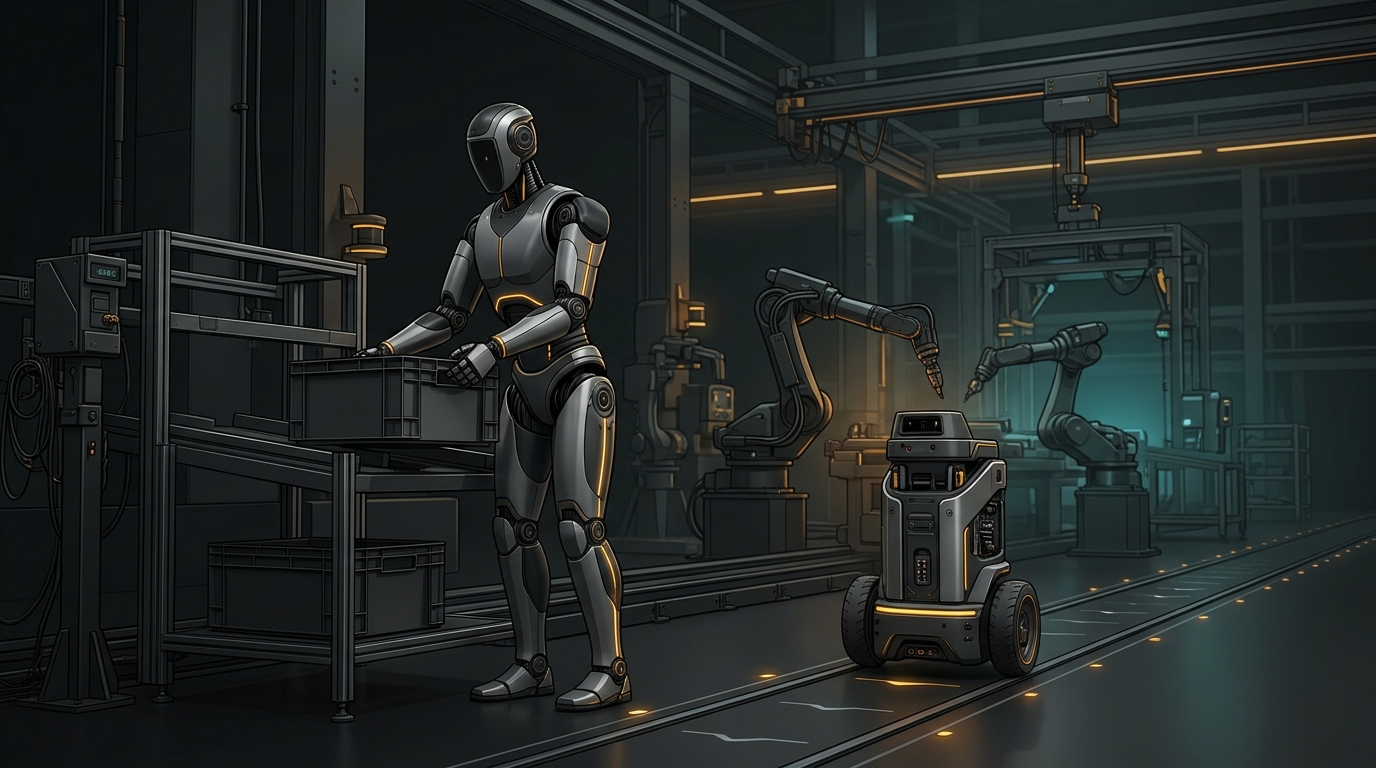
Humanoid robotics is riding an unprecedented wave of excitement. Startup valuations are reaching billions, venture capital is pouring in at record speed, and announcements from companies like Figure AI, Apptronik, Unitree, NEURA Robotics, and Tesla dominate industrial headlines. The commercial demand appears insatiable.
But who is actually writing the checks for the first batches?
If you look at the real-world commitments lined up for the first 1,000 to 10,000 commercial units, the early buyers are not consumer tech brands or novelty seekers. They are large automotive manufacturers, global logistics operators, and energy utilities:
 BMW Group ×
 Figure AI &
 Hexagon Robotics: Deployed Figure 02 robots in Spartanburg (US) to assemble over 30,000 X3 vehicles, and rolling out Hexagon’s wheeled AEON robot in Leipzig (Germany) for battery assembly.
 Renault Group × Wandercraft: Preparing to integrate up to 350 Calvin-40 humanoid robots across French and Spanish assembly plants.
- Mercedes-Benz × Apptronik: Testing the Apollo robot for component kitting in Berlin, backed by a direct corporate equity investment.
- Audi × Agile Robots: Running trials with dual-arm robots in Ingolstadt for demand-driven parts sequencing.
- GXO Logistics & Amazon × Agility Robotics: Validating fleets of bipedal robots (Digit) across live fulfillment hubs, moving over 100,000 totes.
- E.ON × NEURA Robotics &
 Eni × Generative Bionics: Energy infrastructure operators piloting cognitive humanoids for outdoor electrical substations and chemical facility inspections.
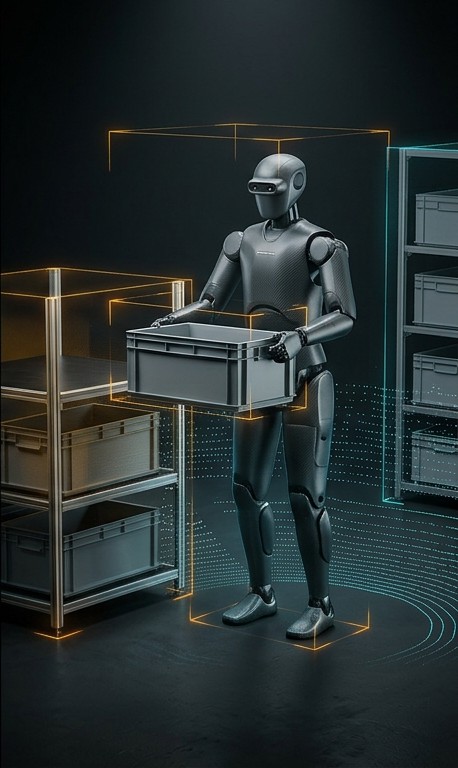
When you look at what these robots are assigned to do on the factory floor, there is a striking pattern: they are moving plastic storage boxes, carrying component trays, sequencing parts carts, and walking down aisles to inspect equipment.
Why would multi-billion-dollar corporations pay six-figure sums for human-shaped machines to do basic warehouse work? Is this a genuine operational need, a corporate preference for innovation prestige, or a response to deeper economic forces?
The assumption that humanoids are being purchased as versatile substitutes for skilled craftsmen and machine operators.
Early units are targeted almost exclusively at brownfield intralogistics: moving parts between lines where shift labor is costly or unavailable.
1. Need, Preference, or Survival? Deconstructing the Real Drivers
When corporate executives announce robotics partnerships, PR releases cite familiar talking points. But when you examine the underlying economics, a more complex picture emerges.
Driver 1: The “Labor Shortage” Narrative — Myth vs. Reality
The most common explanation given for humanoid adoption is a demographic labor collapse: older workers retiring and open positions going unfilled.
Does this claim hold up to scrutiny?
- The Contradiction: While automakers cite labor shortages, major European carmakers and Tier-1 suppliers are simultaneously cutting thousands of factory and administrative positions due to slowing vehicle sales. If people are being laid off, why claim there is no one to carry boxes?
- The Real Mechanism: Carrying a plastic tote does not require an endangered artisan skill. The bottleneck is not an absolute shortage of human beings—it is an economic and shift-work mismatch.
- In Western Europe, fully burdened shift labor costs between €45 and €60 per hour once night-shift premiums, pension contributions, holiday pay, and sick leave are included.
- Paying €50/hour for an operator to walk back and forth carrying plastic boxes across a 02:00 AM third shift destroys manufacturing margins.
- Furthermore, strict European labor regulations make adjusting permanent headcount expensive and rigid. Industrial companies want variable, scalable operational capacity that can be turned on or off without multi-year severance negotiations.
Driver 2: The Existential Pressure of the China Price War
A critical factor rarely highlighted in robotics press releases is the collapsing margin structure of the European automotive industry:
- European carmakers face slowing demand for high-priced electric vehicles and aggressive competition from Chinese manufacturers (such as BYD, Geely, and Xiaomi).
- Chinese plants operate with dramatically lower labor and energy costs, integrated domestic supply chains, and rapid production cycles.
- With European wage levels and energy prices at historical highs, carmakers cannot lower their costs by cutting salaries. Automating repetitive material handling is one of the few remaining levers to slash unit assembly costs and defend operating margins against lower-priced imports.
Driver 3: The Brownfield Constraint — Why Conveyors Fail in Existing Plants
If the objective is simply to move a plastic tote from Point A to Point B, fixed machinery (such as automated roller conveyors, overhead gantries, or automated storage systems) is far faster, cheaper, and more reliable than a two-legged robot.
Why, then, are companies experimenting with humanoids?
- The Cost of Facility Shutdowns: Existing assembly plants were built for people—with narrow walkways, fire doors, ramps, and manual workstations. Installing fixed conveyor belts requires ripping up concrete and shutting down assembly lines for weeks or months. In an automotive plant where a single hour of unplanned downtime can cost upwards of €100,000, tearing up the floor is financially out of the question.
- The Brownfield Advantage: A humanoid or mobile torso robot enters an existing building through standard doorways, walks down existing aisles, and picks up standard containers without altering a single meter of facility infrastructure.
Humanoids are not being deployed because they are mechanically superior to dedicated machines; they are being tested because adapting the machine to the factory is cheaper than rebuilding the factory around the machine.
2. Who Is Buying? A High-Level Sector Overview
Early commercial pilots are heavily concentrated in three core industries:
Automotive Manufacturing & OEM Assembly
~65% of Early PilotsBMW, Mercedes-Benz, Audi, Renault.
Focused on high-volume, repetitive kitting, parts sequencing, and staging components for welding and battery assembly lines without modifying legacy conveyors.
Contract Logistics & 3PL
~25%GXO Logistics, Amazon, DHL.
Testing units to transfer empty and loaded totes between sorting stations and trailer unloads in high-throughput fulfillment centers.
Energy & Heavy Infrastructure
~10%E.ON, MITNETZ STROM, Eni.
Deploying units to navigate outdoor gravel yards, climb substation stairs, and visually inspect high-voltage switchgear.
The Pragmatic Engineering Divide: Legs vs. Wheels
A major technical revelation from these early pilots is that not all “humanoid” robots have legs:
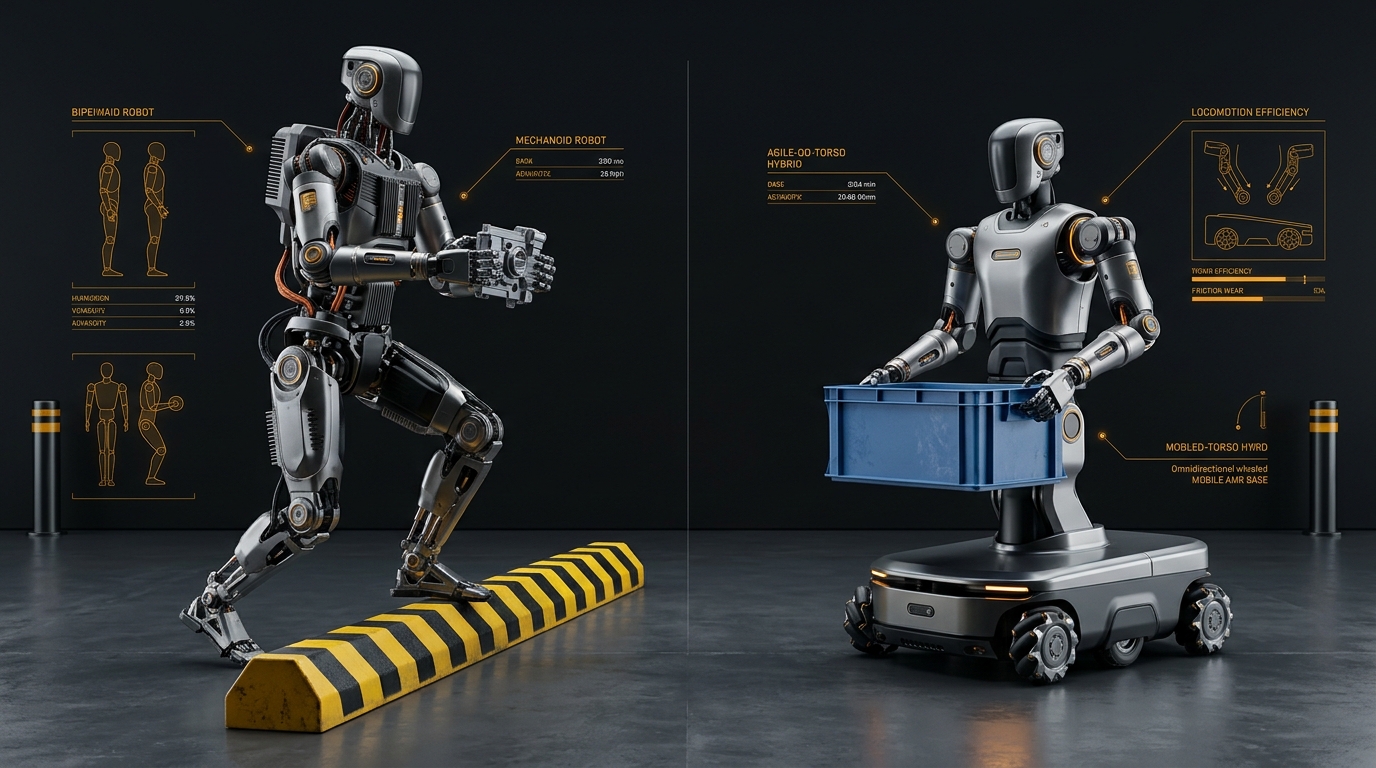
Articulated Bipedal Walker
Figure 02, Apptronik Apollo, Wandercraft Calvin-40, NEURA 4NE-1
- ✓ Stairs & Curbs: Can climb outdoor steel steps and clear floor cables or pipes
- ✓ Narrow Footprint: Navigates tight aisles down to 800 mm without turning radius limits
- ✗ Severe Energy Penalty: Consumes 50%–70% of battery purely on dynamic inverted-pendulum balancing
- ✗ Short Shift Window: Only 2 to 3 hours of continuous runtime before battery swapping or docking
- ✗ Mechanical Wear: 12+ high-torque joint actuators subjected to cyclic impact loads on hard concrete
Wheeled Torso Hybrid
Hexagon AEON (BMW), Agile Robots (Audi)
- ✓ Full Shift Runtime: 8 to 10 hours continuous operation on a single charge thanks to low rolling resistance
- ✓ Higher Transport Speed: Reaches 1.5–2.0 m/s safely on flat plant floors without tip-over risk
- ✓ Lower BOM & Maintenance: Eliminates complex leg gearboxes; uses proven AGV/AMR drive units
- ✗ Requires Level Concrete: Cannot climb stairs, curbs, or clear loose cables across pathways
- ✗ Larger Turning Radius: Needs min. 1,100–1,200 mm clear aisle widths for smooth passage
For indoor manufacturing with level concrete floors, the wheeled hybrid is winning the battle for short-term operational practicality. By decoupling the human-like upper torso (dexterity, camera perspective, dual-arm manipulation) from the legs (which provide zero benefit on flat concrete), manufacturers solve the shift-duration problem today without waiting for multi-year battery chemistry breakthroughs.
3. What Makes This New Age of Robotics Different? The Three Eras of Automation
Industrial robots have welded car bodies and painted chassis panels for more than fifty years. What sets the current generation apart from traditional automation?
The 50-Year Paradigm Shift in Industrial Robotics
The progression of industrial robotics is defined by a gradual migration from rigid, deterministic mechanics to adaptive, sensory-guided physical intelligence:
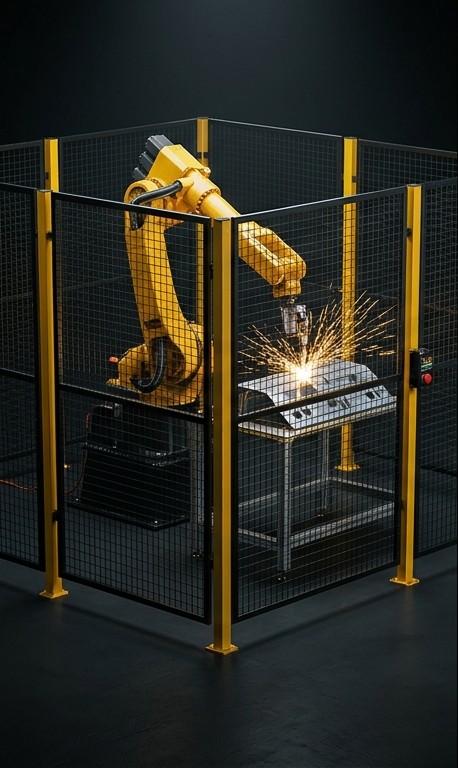
Traditional Industrial Arms
Fenced 6-Axis Articulated & SCARA Units
The heavy backbone of 20th-century mass manufacturing. Engineered for uncompromising velocity and sub-millimeter repeatability inside physical safety cages that keep human operators safely outside the hazard zone.
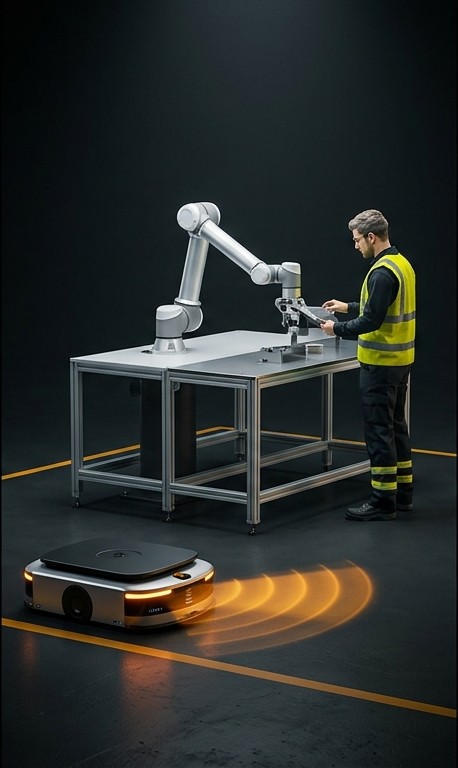
Collaborative Cobots & Autonomous Mobile Robots (AMRs)
Force-Limited Lightweight Arms & 2D LiDAR Mobile Bases
The collaborative revolution dissolved the safety fence. By integrating internal torque sensors, speed-and-separation monitoring, and autonomous navigation, robots began sharing the shopfloor alongside human operators.
Physical AI & Modern Humanoids
Vision-Language-Action (VLA) Models & Neural Spatial Policies
The leap from hardcoded kinematics to cognitive spatial reasoning. Instead of programming rigid waypoints, neural network policies process live 3D visual data to adaptively manipulate unmodeled objects in dynamic brownfield environments.
4. The Vision Myth: Why Adding Cameras to Fixed Arms Isn’t Enough
A common narrative in robotics marketing suggests that humanoids are necessary because traditional industrial robots are “rigid and blind.”
In reality, modern 6-axis articulated arms (from Fanuc, KUKA, ABB, and Yaskawa) have been equipped with sophisticated 2D and 3D machine vision systems (Keyence, Cognex, Photoneo, Pickit) for decades. An industrial robot can easily detect a rotated billet, locate a misaligned part in a bin, and dynamically calculate coordinate offsets in fractions of a second.
The push toward humanoid and mobile dual-arm robotics is driven by a completely different physical constraint: the cost and physical impossibility of re-engineering brownfield plant layouts around fixed automation.
Auxiliary Equipment Chains and Retooling Cascades
Equipping a legacy robotic cell with a vision system rarely solves the end-to-end material flow. If an incoming component arrives outside the robot’s physical reach envelope or joint limits, adding a camera does not help:
- Auxiliary Equipment Chains: Plants often must install mechanical pre-centering jigs, motorized turnover tables, or even a second upstream robot just to re-orient the part so the primary arm can grasp it.
- Line-Level Alterations: Conveyor speeds, transfer heights, and safety fences must be modified. What begins as adding a vision camera quickly cascades into a €100,000+ line-retooling project requiring weeks of engineering and production halts.
The Bolted Base Constraint: Fixed Kinematics Cannot Cross the Shopfloor
A fixed 6-axis industrial arm—regardless of how advanced its vision software is—remains bolted to a concrete foundation. It is confined to a fixed ~1.5 to 3.0-meter spherical work envelope:
- The Inter-Station Void: A fixed arm cannot walk 12 meters down an aisle to pull a VDA-KLT tote from shelf tier 3, navigate around a forklift, and deliver it to a stamping press.
- The Conveyor Penalty: Connecting isolated islands of fixed robotics requires installing dedicated roller conveyors, pneumatic transfer lines, or overhead gantries. In a brownfield automotive plant, running fixed conveyors through active walkways destroys shopfloor flexibility and can cost upwards of €100,000 per hour in production downtime during installation.
Spatial Drop-In Compatibility: The Real Purpose of the Humanoid Form
Automotive assembly plants, component warehouses, and manufacturing shops were designed specifically for the human body: 900 mm pedestrian doorways, vertical flow racks ranging from ankle to eye level (30 cm to 180 cm), and manual tugger carts.
The real engineering promise of a humanoid or mobile hybrid torso is not that it “sees better” than a fixed arm, but that it provides spatial drop-in compatibility:
- Zero Infrastructure Alteration: It fits into the physical space previously occupied by a human operator—walking down existing pedestrian aisles, opening manual doors, reaching into multi-tier shelving, and picking containers with dual-arm dexterity.
- Replaces Facility Rebuilding: Instead of spending millions of euros reconstructing an active factory around fixed conveyors and indexing tables, manufacturers can deploy an autonomous mobile platform directly into existing brownfield architecture.
Speed and Determinism vs. Probabilistic Flexibility
While mobile humanoids and Physical AI solve the brownfield spatial puzzle, plant managers must balance this against severe operational trade-offs:
- Cycle Speed: A fixed SCARA or Delta robot equipped with vision can sort or tend parts at 60 to 120 cycles per minute. A humanoid moving a tote operates at a deliberate, human pace (often 10–20 seconds per pick cycle).
- Deterministic Reliability vs. Probabilistic Models: A traditional robotic arm running deterministic PLC code achieves mean time between failures (MTBF) measured in tens of thousands of hours. Humanoids rely on probabilistic neural policies and complex electromechanical drivetrains that are still in their multi-year reliability proving phase.
Fixed automation remains vastly superior, faster, and cheaper for high-speed, unchanging tasks. Humanoid and mobile dual-arm systems only become competitive when production tasks span large brownfield spaces or when physical facility constraints make fixed conveyor systems prohibitively expensive to install.
5. The Economic Equation: When Does the Math Work?
What does this technology actually cost, and what must happen for it to make commercial sense?
€15 – €22 / hr
Projected Robots-as-a-Service (RaaS) hourly rate at volume scale, providing immediate operational savings compared to burdened Western European shift labor (€45–€60/hr).
Upfront Purchase vs. Robots-as-a-Service (RaaS)
Today, early pilot humanoids carry an estimated hardware Bill of Materials (BOM) of roughly $80,000 to $120,000, with fully packaged pilot deployments often exceeding $150,000 to $200,000 once integration and engineering support are factored in.
At this price point, an upfront capital purchase makes little sense for most operations. As a result, the commercial model is shifting toward Robots-as-a-Service (RaaS):
- Instead of committing to a large capital write-off, plants pay an hourly operating fee (currently €20 to €30 per hour in early pilots, with targets to reach €15 per hour as manufacturing volumes scale).
- Compared to burdened factory shift costs in Germany or France, an effective €18/hour service contract that handles night-shift material runs yields direct operating cost savings without adding balance-sheet debt.
6. Geopolitics & Global Power Dynamics
The race to deploy physical automation is directly intertwined with international industrial competitiveness:
| Global Region | Primary Strength | Critical Vulnerability | Strategic Priority |
|---|---|---|---|
United States
Silicon Valley & Texas | AI foundation models, advanced simulation software (NVIDIA Isaac, OpenAI), venture capital depth | High domestic manufacturing costs; heavy reliance on Asian motors and permanent magnet supply chains | Licensing physical AI software platforms and robot operating systems globally |
 China
Shenzhen & Yangtze Delta | Dominant electromechanical supply chain, 70%+ rare-earth magnet refining, low chassis production costs | Potential access restrictions to advanced semiconductor technologies; statistical AI reliability gaps | Mass-producing robot chassis at a fraction of Western costs to dominate global supply |
 Europe
DACH, France & Italy | World-class systems integration (Sondermaschinenbau), functional safety certification (TÜV, CE, ISO 13849), precision engineering | High industrial energy prices, slower venture funding velocity, strict regulatory procedures | Integrating certified automation into existing manufacturing plants to preserve industrial sovereignty |
Critical Dependencies: Electromechanical Supply Chains vs. Systems Integration
- Electromechanical Supply Chains: High-performance robotic joints require specialized rare-earth permanent magnets (neodymium). China currently refines over 70% of the world’s rare earths, giving it significant leverage over global component pricing.
- Industrial Systems Integration: Having a capable robot is only half the battle. The robot must be safely integrated into the plant’s existing PLCs (Programmable Logic Controllers), safety circuits, and production databases. This integration expertise remains heavily concentrated among European and American engineering firms.
7. The Unspoken Risks: Safety Certification & Data Security
Two major technical hurdles receive little attention in promotional videos, but represent significant practical hurdles on the shopfloor:
The Reliability Boundary: Probabilistic AI vs. Deterministic Shopfloors
AI vision-language models are fundamentally probabilistic. A 98% grasping success rate sounds stellar in robotics benchmark papers. But on an automotive assembly line producing 60 vehicles per hour, a 2% failure rate means heavy metal stamped parts, battery modules, or KLT totes are dropped dozens of times every shift—halting lines, damaging tooling, or risking injury.
Industrial machinery directives demand deterministic, fail-safe architecture (Performance Level d / Category 3). Until neural policy models can guarantee deterministic stop envelopes or operate alongside certified optical safety scanners, mobile humanoids cannot legally share open production aisles with human operators.
The Roaming Camera Threat: Cloud Telemetry vs. Shopfloor Sovereignty
A humanoid or mobile dual-arm robot is equipped with 3D depth cameras, high-resolution RGB sensors, and omnidirectional microphones. If these robots continuously stream operational video feeds and tactile telemetry to public cloud servers for AI model fine-tuning, proprietary plant floorplans, jig configurations, and upcoming product CAD geometries risk leaving the facility.
European manufacturers cannot afford to have proprietary manufacturing processes or trade secrets uploaded to foreign cloud providers. Production-grade deployments demand strictly air-gapped, on-premise edge compute where all inference and telemetry remain confined within the plant's local OT firewall.
8. What This Means for the European Mittelstand: Why SMEs Should Wait
If you manage or own a small-to-mid-sized manufacturing facility (50 to 500 employees), the public debate around humanoid robotics often feels disconnected from your day-to-day shopfloor reality.
Humanoid robotics startups market almost exclusively to Fortune 500 automotive conglomerates and global logistics operators. For a plant manager running a toolmaking shop in Solingen, a metal stamper in Sauerland, or a machinery business in Velbert, watching social media demos of humanoids doing backflips or folding laundry doesn’t answer the core operational question: Does this technology make economic sense for my plant today?
The short, grounded answer is no—not in 2026 or 2027.
The Enterprise Beta-Tester Phase
The first 10,000 humanoid robots rolling off production lines are corporate test-bed deployments. Automotive conglomerates like BMW, Mercedes-Benz, and Renault possess dedicated corporate innovation labs, venture capital cushions, and engineering teams capable of absorbing broken actuators, unexpected sensor failures, and software halts.
A mid-sized manufacturer cannot afford to become an unpaid beta tester:
- The Downtime Penalty: When an experimental humanoid drops a component or experiences a vision-policy timeout, corporate labs log the telemetry data for model retraining. In a mid-sized contract manufacturing plant, an unexpected line stoppage halts order delivery and incurs immediate customer penalties.
- The Integration Overhead: Today’s humanoids lack off-the-shelf, standardized interfaces for legacy PLCs (Siemens S7, Beckhoff, Rockwell) or local ERP work-order dispatchers. Making them work in brownfield plants requires bespoke software engineering and extensive safety validation.
- The CapEx Misalignment: Committing €100,000 to €150,000 in upfront capital expenditure for an unproven, rapidly depreciating robot chassis with an unknown multi-year MTBF (Mean Time Between Failures) is financially indefensible for a 100-person company.
Proven Automation Paths That Deliver Immediate ROI
While humanoids work through their multi-year enterprise development curve, small-to-mid-sized manufacturers can achieve immediate operational returns by focusing on two proven deployment strategies:
Robots-as-a-Service (RaaS)
Flexible OpEx Subscription • Zero Balance-Sheet Debt
Instead of committing €100k–€150k in upfront capital write-offs, plants access automation through operational expense subscriptions (€1,200 to €2,500 monthly).
- ✓ Risk Transferred to Vendor: Providers like RobCo, Formic, and Igus RBTX supply hardware, tooling, safety certification, and maintenance, carrying the operational uptime risk.
- ✓ Immediate Margin Relief: An effective €18/hour service contract replaces €45 to €60/hour burdened human night shifts with zero balance-sheet risk.
Modular Bottleneck Workcells
Targeted Cobots & AMRs • High-Mix Brownfield Tasks
Rather than attempting general-purpose flexibility, pragmatic SMEs deploy proven cobots and wheeled mobile platforms on isolated, high-turnover bottlenecks:
- ▸ CNC Machine Tending: Automating billet loading and chuck cycling to unlock 40 to 60 additional spindle hours across unmanned 2nd and 3rd shifts.
- ▸ 24/7 Injection Demolding: Extracting hot plastic parts and trimming sprues to stabilize cycle times and relieve acute operator turnover.
- ▸ End-of-Line Palletizing: Stacking heavy cartons (10–25 kg) to eliminate the leading cause of chronic musculoskeletal injury claims.
Practical Shopfloor Readiness: Four Steps for SMEs Today
Whether an SME intends to deploy modular RaaS automation this year or mobile hybrid robots by 2029, the baseline preparatory steps require zero robotic hardware:
- Standardize Internal Containers: Phase out irregular cardboard boxes and non-standard bins in favor of standardized industrial containers (such as VDA-KLT totes). Predictable container geometry is the single biggest prerequisite for reliable robotic manipulation.
- Clear Aisle Geographies: Establish minimum aisle clearances of at least 1,100 mm and eliminate loose cables or uneven floor thresholds so that wheeled AMRs can navigate cleanly.
- Air-Gap Operational Data: Ensure your factory OT network is physically segmented from general office internet connections, keeping machine telemetry and tooling layouts on-premise.
- Digitize Work-Order Dispatching: Automated equipment cannot read paper clipboards. Implementing lightweight digital job-dispatching (even simple local databases or digital kanban boards) creates the data bridge needed for robots to receive tasks.
This publication is Part 1 of a 3-part research group analyzing the automation transition across macro economics, financial models, and shopfloor deployment:
9. Executive Summary: From Lab Benchmarks to Industrial Reality
The first 10,000 humanoid robots will not suddenly replace human workforces across the globe. They are being purchased by capital-rich automotive and logistics corporations to solve acute labor bottlenecks in facility environments they cannot afford to rebuild.
For small-to-mid-sized manufacturers, the strategic path forward is clear:
- Let Conglomerates Fund the Learning Curve: Allow multi-billion-dollar automotive Tier-1s to absorb the early software bugs, sensor failures, and physical wear cycles.
- Explore Flexible OpEx Models: When automating high-turnover tasks like machine tending and palletizing, evaluate Robots-as-a-Service (€15–€22/hr) to avoid balance-sheet debt.
- Standardize the Physical Baseline: Focus immediate internal efforts on standardizing containers (KLT totes), clearing aisles, and digitizing dispatch data so your facility is primed when modular robotics reaches commercial maturity.
The winners of this automation transition will not be those who rush to purchase the flashiest robot on social media. They will be the pragmatic manufacturers who turn flexible automation into positive monthly cash flow.
Deploying Robotic Systems or Need Software to Connect Your Shopfloor?
A robot arm or AMR is only as useful as the software directing it. Mintmal helps technical teams and machine builders build the digital layer around physical automation: developing custom Python/MQTT middleware, connecting robot controllers to local databases and ERPs, and building automated data pipelines that eliminate manual paperwork on the shopfloor.
Reference Ledger & Empirical Sources
- BMW Group Plant Spartanburg: Production deployment of Figure 02 humanoid robots handling sheet metal loading into welding fixtures (>30,000 BMW X3 vehicles produced; 1,250 operating hours logged). BMW Group Corporate Communications & Figure AI (2025/2026).
- BMW Group Plant Leipzig & Hexagon Robotics: Deployment of the wheeled-base AEON robot for high-voltage battery assembly and component line delivery. BMW Group Smart Robotics & Hexagon AB (2026).
- Audi AG & Agile Robots SE: Testing mobile dual-arm humanoids for demand-driven parts sequencing in the Ingolstadt Production Lab. Audi MediaCenter (2025/2026).
- Mercedes-Benz AG & Apptronik: Apollo humanoid deployment for assembly kit delivery and intralogistics at the Mercedes-Benz Digital Factory Campus (MBDFC) Berlin-Marienfelde. Mercedes-Benz Media & Apptronik Inc. (2024–2026).
- Renault Group & Wandercraft: Commercial roadmap for up to 350 Calvin-40 bipedal robots for heavy component logistics in French and Spanish assembly plants. Renault Group Strategic Manufacturing Communications (2026).
- Logistics & Warehousing Deployments: GXO Logistics testing of Agility Robotics (Digit) and Apptronik (Apollo) moving >100,000 totes across live distribution centers; Amazon testing Digit at fulfillment hubs. GXO Logistics & Agility Robotics Field Reports (2024–2026).
- E.ON SE & NEURA Robotics: Training cognitive 4NE-1 humanoids for high-voltage substation switchgear inspections at TUM RoboGym. E.ON Group & NEURA Robotics (2026).
- Eni S.p.A. & Generative Bionics: Field validation of GENE.01 bipedal robots featuring distributed tactile smart skin for chemical and energy infrastructure monitoring. Eni Next (2026).

About Mintmal
Mintmal delivers practical AI and software systems with engineering rigor from Wuppertal, Germany. From AI telephone automation for trades to sovereign open-source systems.