Skydio F10 vs. Human Security Patrols: How Effective Is It for European Plants?
How effective is the 100 mph Skydio F10 fixed-wing drone and MegaDock against traditional human guard patrols in Europe? We audit perimeter coverage, EASA BVLOS rules, 3-year TCO math, and US CLOUD Act risks.
For over a decade, the industrial “drone-in-a-box” market has been defined by rotary-wing multicopters. Quadcopters and hexacopters housed inside weatherproof doghouses—such as the DJI Dock, Perceptual Robotics pods, or Skydio Dock for X10—have demonstrated automated takeoffs, short perimeter patrols, and battery-swapping sequences.
Yet for operators of sprawling critical infrastructure—such as chemical parks, open-cast quarries, interstate pipeline networks, high-voltage transmission lines, and maritime container ports—multicopter physics present an intractable ceiling. A standard commercial multicopter cruising at 35 to 45 mph (56 to 72 km/h) exhausts its lithium pack within 25 to 35 minutes, limiting its reliable operating radius to barely 3 to 5 kilometers before it must scramble back to base.
With the unveiling of the Skydio F10 Lightrunner and the MegaDock, American drone manufacturer Skydio has fundamentally shifted the hardware paradigm: marrying high-speed fixed-wing aerodynamics with a 5-aircraft automated robotic docking terminal.
Boasting a sprint velocity of 100 mph (160 km/h), a 30-mile (48 km) operational radius, and a revolutionary Robotic Takeoff and Landing (RTOL) suction-catch arm, the system promises persistent, 24/7 rotating aerial surveillance without human launch crews, runways, or catapults.
For European plant directors (Technischer Leiter), security chiefs, and industrial machine builders, the F10 raises urgent technical and strategic questions: Does an American fixed-wing robotic dock solve real operational perimeter bottlenecks? Can it pass EASA Specific Category SORA regulatory audits for Beyond Visual Line of Sight (BVLOS) flight? How does it integrate with on-premise Video Management Systems (VMS) without falling foul of the U.S. CLOUD Act and European GDPR mandates? And what does the all-in Total Cost of Ownership (TCO) look like when accounting for civil engineering, battery degradation, and proprietary cloud subscriptions?
Below is an independent, deep-dive engineering audit of the Skydio F10 Lightrunner and MegaDock ecosystem.
High-speed fixed-wing cruise paired with a 5-bay automated ground station using a robotic suction gripper to catch aircraft out of mid-air without runways.
Consecutive 90-minute flights staggered across 5 climate-controlled bays with 30-minute rapid recharge cycles for non-stop aerial presence.
1. System Teardown: How the F10 Lightrunner and MegaDock Work
To evaluate the F10, one must first dissect the engineering mechanics that distinguish it from conventional fixed-wing unmanned aerial vehicles (UAVs) and traditional drone docks.
System Architecture: MegaDock 5-Bay Autonomous Flight & Hot-Rotation Cycle
Automated Dock Launch
- ▸ 5-bay climate-controlled terminal with robotic arm
- ▸ Rapid 20–30s scramble into wind airflow (no human crew)
100 mph Autonomous Mission
- ▸ 160 km/h sprint speed across a 30-mile operational radius
- ▸ SideEye 360° optical/thermal gimbal clear of prop arc
RTOL Catch & Rapid Recharge
- ▸ Zero-runway mid-air suction catch mechanism
- ▸ 30–45 min automated recharge across 5 rotating bays
The F10 Lightrunner Airframe & SideEye Optics
Fixed-wing aircraft generate lift through forward motion over aerodynamic airfoils, consuming roughly a quarter of the energy per kilometer traveled compared to hovering multicopters. However, traditional fixed-wing platforms suffer from two major sensor flaws:
- Camera Obstruction During Turns: When a fixed-wing drone banks into a 45-degree turn to orbit an intruder or an industrial flare stack, the inner wing or propeller arc directly obscures the camera gimbal.
- Propeller Heat and Shutter Artifacts: Nose- or belly-mounted gimbals frequently capture propeller shimmer or exhaust heat blur.
Skydio resolved this with an asymmetrical airframe architecture termed SideEye. Unlike conventional aircraft with a center-mounted fuselage pod, the F10 features an asymmetric side-pod layout: the dual-sensor optical/radiometric thermal gimbal is mounted offset on an outrigger pylon positioned completely outside the propeller arc and wing dihedral line. Regardless of high-G banking angles, the camera maintains an uninterrupted 360-degree line of sight on ground targets.
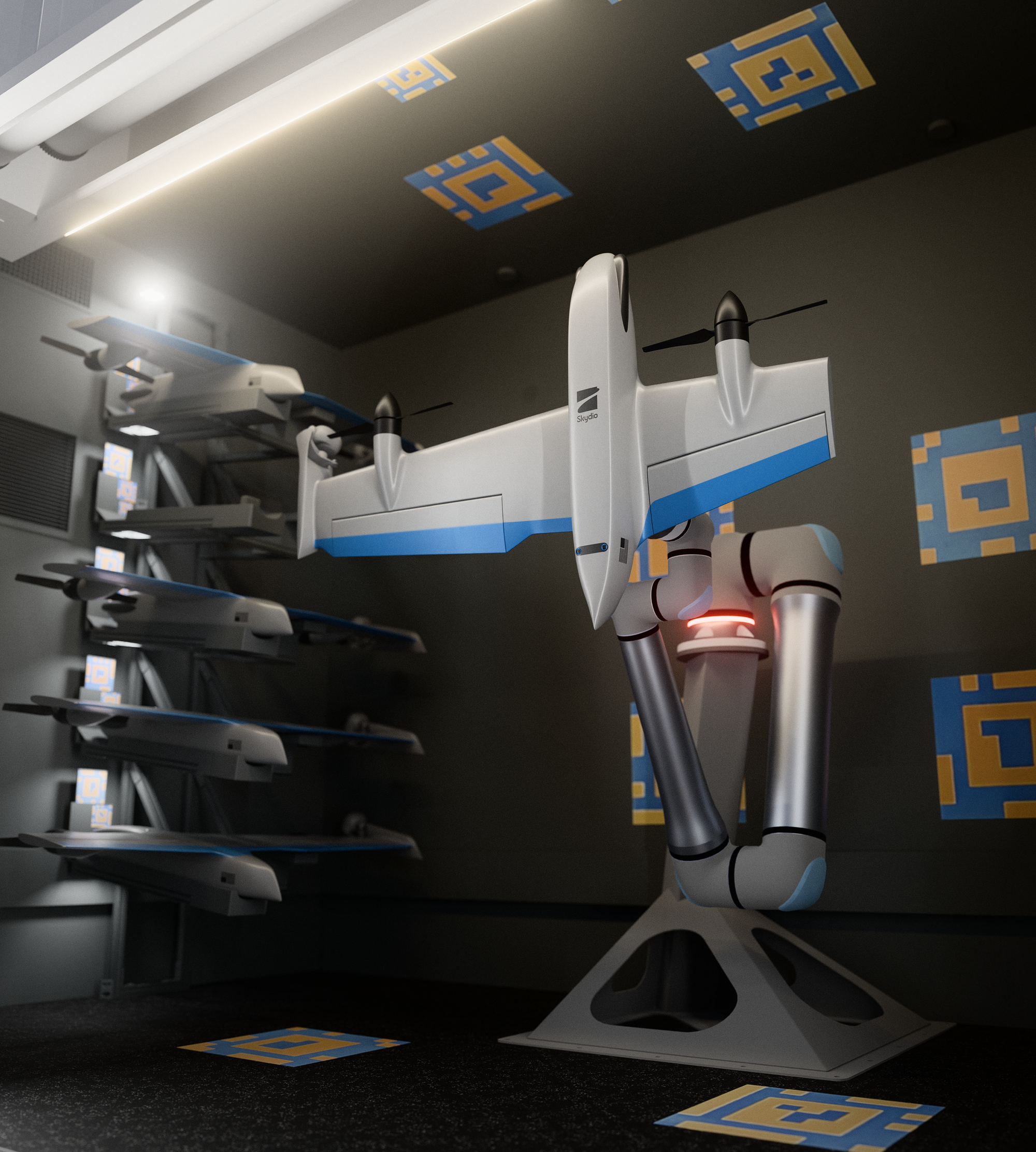
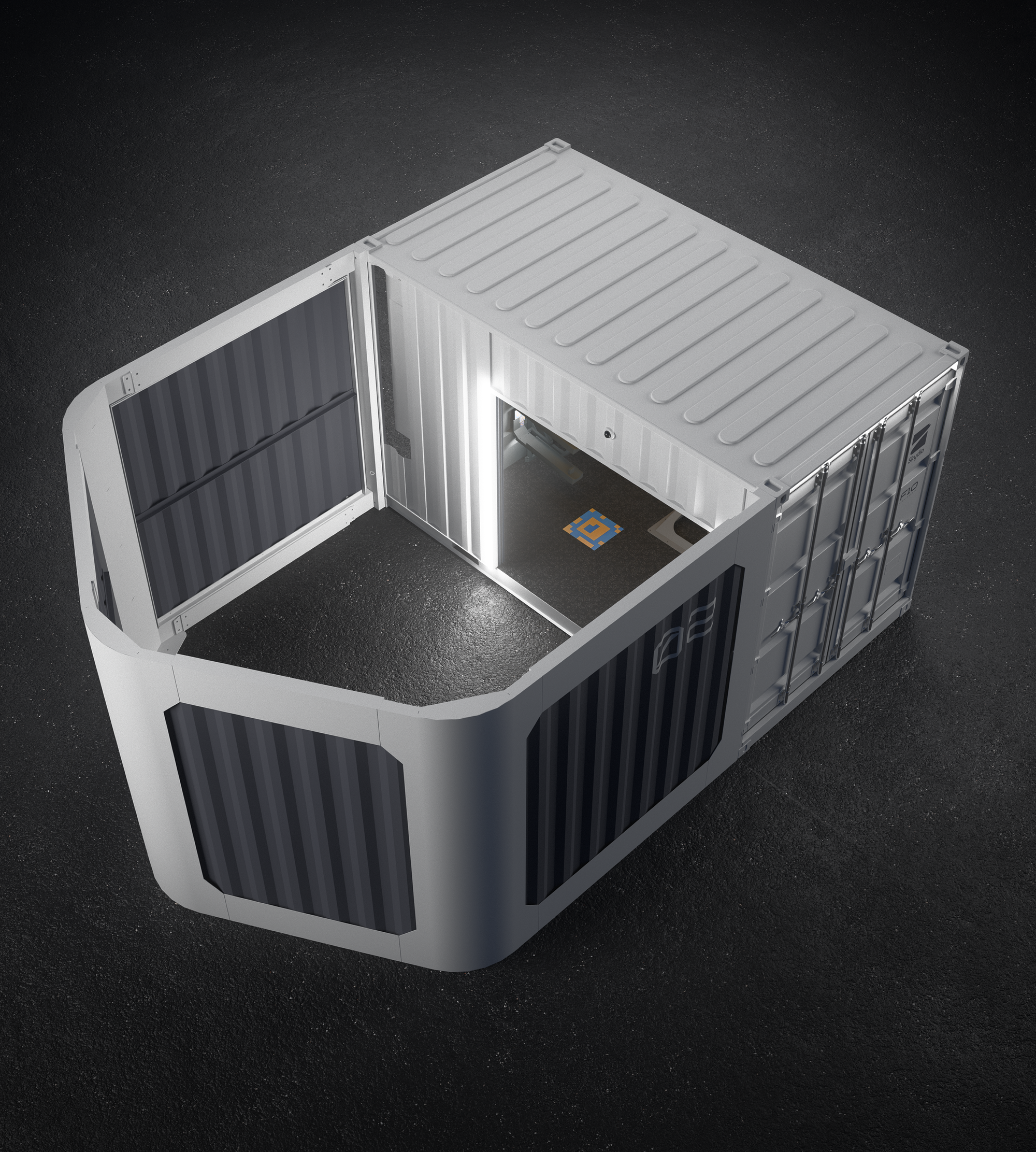
The aircraft is powered by an onboard compute cluster combining NVIDIA Jetson Orin and Qualcomm Snapdragon silicon, executing real-time vision algorithms:
- Skydio Pathfinder: Local visual odometry, dynamic spatial re-routing, and geocage boundary enforcement that operates even in GPS-denied or RF-jammed corridors.
- Skydio Foresight AI: 360-degree computer-vision obstacle avoidance that maps power lines, light poles, tower cranes, and guy-wires in real-time, preventing the common collision failure modes that plague blind fixed-wing drones.
The MegaDock & Robotic Takeoff and Landing (RTOL)
The operational Achilles’ heel of fixed-wing drones has always been recovery. Multicopters land vertically on small pads. Fixed-wing drones historically required one of three messy compromises:
- A paved runway (unrealistic in rugged industrial yards).
- A pneumatic catapult launcher and belly landing on grass (which destroys sensitive optical gimbals over time).
- A mechanical arrestor wire, bungee trap, or nylon catch net (requiring a two-person ground crew to untangle and reset).
The MegaDock bypasses all three via Robotic Takeoff and Landing (RTOL). The dock is a ruggedized, climate-controlled container measuring roughly 14.5 by 20.75 feet (4.4 x 6.3 meters), engineered to withstand Category-2 hurricane wind loads when anchored to a reinforced concrete pad.
Inside the enclosure sits an articulated high-speed industrial robotic arm terminating in an array of high-flow pneumatic suction cups:
- Automated Launch: When an alarm trips (from an integrated radar, seismic fence sensor, or scheduled patrol routine), a roof hatch slides open. The robotic arm lifts the F10 from its internal charging cradle into the ambient airflow, checks motor RPM and control-surface deflections, and releases the aircraft into flight within 20 to 30 seconds.
- Mid-Air / Precision Recovery: Upon mission completion, the F10 executes an autonomous glide approach toward the dock. Computer-vision markers and precision RF beacons synchronize the aircraft’s vector with the robotic arm. As the F10 crosses the dock threshold at low stall speed, the robotic arm matches its trajectory, engages the suction gripper against a reinforced contact plate on the fuselage, decelerates the aircraft, and folds it safely inside the hull.
- 5-Aircraft Hot Rotation: The MegaDock houses up to five F10 aircraft simultaneously. Because each aircraft provides approximately 90 minutes of cruise endurance and requires roughly 30 to 45 minutes of automated fast-charging, a single MegaDock can maintain continuous, non-stop overlapping air cover (persistent hot rotation) 24 hours a day, 365 days a year, with zero humans on site.
Autonomous Mission & 5-Bay Hot-Rotation Lifecycle
Motorized roof panels open. Articulated arm lifts aircraft from charging bay into ambient airflow and releases it into flight within 20–30s.
High-speed sprint to target coordinate. SideEye optics maintain 360° lock while Foresight AI avoids transmission towers and crane wires.
Aircraft descends on low stall-speed glide path. Optical docking markers and IR beacons synchronize relative vector with MegaDock threshold.
Multi-axis robot arm matches incoming drone speed, engages pneumatic suction pads against reinforced fuselage plates, and decelerates airframe.
Drone is transferred to climate-controlled rack for automated fast-charging, while a fully-charged sister aircraft is staged for next launch.
2. The Operational Bottleneck: How Industrial Perimeter Security Failed Before
To understand why an enterprise would evaluate a multi-aircraft fixed-wing dock, one must examine the counterfactual reality of expansive industrial perimeter management across Europe.
Manned 4x4 Mobile Patrols
- ✗ Severe Response Lag: 15–25 minutes to drive to remote perimeter breaches across 10 km+ fence lines.
- ✗ Punishing Labor OpEx: 24/7 coverage requires 4.5–5 FTE guards per vehicle shift (€250k–€320k/yr).
- ✗ Zero Aerial Vantage: Blind spots behind berms, pipelines, storage tanks, and rail sidings.
Multicopter Drone-in-a-Box
- ✓ Automated vertical takeoff and landing on small footprint.
- ✗ Physics-Constrained Range: 25-minute flight time limits patrol radius to under 4 km.
- ✗ Slow Intercept Speed: Top cruise of 35–45 mph cannot catch moving vehicles or cover multi-mile linear assets.
For operators of chemical complexes (e.g., Chempark Dormagen or Marl in Germany), open-cast lignite mines and gravel quarries (covering 20 to 50 square kilometers), or port authorities (such as Hamburg, Antwerp-Bruges, or Rotterdam), physical security has historically been trapped between two bad options:
- The Trenching Nightmare of Fixed Cameras: Running high-definition optical/thermal PTZ cameras along a 15-kilometer industrial boundary requires civil trenching, armored fiber-optic cabling, and power distribution. In Europe, industrial trenching costs between €60 and €120 per meter. Installing full perimeter camera coverage easily spirals into a €1.5M+ CapEx project before factoring in routine lightning strikes, cable cuts, or foliage obscuration.
- Delayed Response Times: When an infrared beam or microwave perimeter sensor trips at 02:30 AM, dispatching a contracted security guard in a diesel truck takes 15 to 30 minutes to navigate industrial service tracks. By the time security arrives, copper thieves, trespassers, or environmental saboteurs have exited the site.
The F10 Lightrunner changes this timeline from 20 minutes to 90 seconds. Cruising at 100 mph (approx. 45 meters per second), the aircraft can scramble from its dock and arrive over an alarm point 4 kilometers away in under 90 seconds, streaming high-resolution stabilized 4K optical and radiometric thermal video directly to the central control room.
Incident Response: Fence Line Breach at 02:30 AM (4 km from HQ)
3. The Vendor Profile: Ideology, Supply Chains, and the October 2024 Chinese Sanctions
To audit any enterprise automation system, technical directors must look closely at the corporate vendor, its geopolitical posture, and its supply chain resilience.
MIT Roots to Defense Darling
Skydio was founded in 2014 by MIT CSAIL roboticists Adam Bry, Abe Bachrach, and Matt Donahoe, who had previously worked on Google X’s Project Wing. Their foundational philosophy was “Autonomy First”: they argued that human teleoperation was the fundamental barrier to drone scalability. Instead of making better radio-control transmitters, Skydio built full-stack computer-vision engines that fly the aircraft autonomously, treating the human operator merely as a high-level task supervisor.
In 2023, Skydio made a historic strategic pivot: it completely terminated its consumer drone division. The company redirected 100% of its capital and engineering toward enterprise customers, public safety (pioneering Drone as First Responder / DFR programs), and the U.S. Department of Defense. Today, Skydio is the poster child for the U.S. government’s “Blue UAS” framework and an aggressive advocate for federal bans against Chinese manufacturers like DJI and Autel.
The October 2024 Geopolitical Supply Chain Whiplash
This aggressive geopolitical posture produced an immediate, real-world supply chain shock that every European prospective buyer must understand.
In October 2024, the Ministry of Foreign Affairs of the People’s Republic of China announced sweeping sanctions against Skydio in retaliation for U.S. defense sales to Taiwan (where Skydio drones were delivered to Taiwan’s National Fire Agency).
The impact was swift and asymmetric:
- Although Skydio assembles its drones in the United States, its critical lithium-ion battery cells were sourced from a single tier-one supplier: Dongguan Poweramp Technology Ltd. (a Chinese subsidiary of Japan’s TDK Corp).
- Chinese authorities ordered Poweramp to immediately terminate all commercial contracts, shipments, and engineering collaboration with Skydio.
- Caught without a qualified secondary battery manufacturer, Skydio CEO Adam Bry was forced to issue a public open letter announcing emergency battery rationing: existing enterprise and defense clients were restricted to just one battery per drone, and delivery dates for new hardware slipped across the board.
- Skydio leadership had to mount an urgent global sourcing campaign across Taiwan, South Korea, and Japan to establish non-Chinese lithium cell manufacturing and pack assembly lines.
1 Battery / Drone
Skydio's global customer rationing level following October 2024 Chinese sanctions on Poweramp lithium cells.
For a European plant director evaluating a 5-drone MegaDock system that consumes 15 to 20 flight cycles per day, battery supply security is not an academic topic. A multi-aircraft autonomous dock requires a robust, guaranteed stream of replacement battery packs every 12 to 18 months. While Skydio has diversified its supply chains outside the PRC, this incident underscores the severe geopolitical exposure inherent in U.S.-China technology conflicts.
4. The European Data Sovereignty Dilemma: US CLOUD Act vs. KRITIS & GDPR
For plant owners in Germany, Austria, Switzerland, and the wider EU, the primary objection to adopting Skydio is rarely mechanical. It is data sovereignty, regulatory surveillance compliance, and cloud architecture.
Data Architecture: The European Compliance Clash
U.S. CLOUD Act & FISA 702
18 U.S.C. § 2713 grants extraterritorial U.S. warrants lawful reach over AWS data, regardless of whether stored in AWS Frankfurt or Virginia.
EU GDPR Art. 6 & 35 (DSGVO)
Incidental optical capture of public roads & shopfloor employees triggers strict Works Council (§ 87 BetrVG) co-determination & mandatory DPIA.
German IT-SiG 2.0 & NIS2
Critical chemical, energy, and port spatial blueprints cannot traverse foreign commercial SaaS without violating KRITIS compliance.
Local Sovereign VMS (Milestone / Genetec)
Video payload is extracted directly from the MegaDock Edge Gateway over isolated industrial Ethernet (10 GbE) into the plant's on-premise VMS servers behind internal firewalls.
- ✓ Zero Cloud Egress: High-definition video and plant blueprints never touch public WAN.
- ✓ Strict GDPR & KRITIS: Meets German IT-SiG 2.0, NIS2, and Works Council (§ 87 BetrVG) rules.
- ✓ Sub-100ms Latency: Direct control room video walls without internet streaming lag.
Skydio Cloud SaaS (AWS Infrastructure)
Fleet telematics, GPS tracks, 3D point clouds, and remote dispatch signals are routed through public AWS cloud instances managed by Skydio Inc.
- ✗ U.S. CLOUD Act (18 U.S.C. § 2713): Extraterritorial subpoena reach applies regardless of EU server region.
- ✗ FISA Section 702: Unchecked access risks for classified industrial recipes and critical energy topologies.
- ⚠ SaaS Dependency: Loss of WAN backhaul disables multi-dock fleet dispatch and remote monitoring.
The U.S. CLOUD Act & FISA Section 702
Skydio’s enterprise fleet management software—Skydio Cloud, Remote Flight Deck, and Asset Command—is architected natively as an Amazon Web Services (AWS) Software-as-a-Service (SaaS) platform. Flight logs, telemetry, high-precision 3D digital elevation models, GPS tracks, optical video feeds, and radiometric thermal scans are streamed from the dock up to the cloud.
Under the U.S. CLOUD Act (18 U.S.C. § 2713) and Section 702 of the Foreign Intelligence Surveillance Act (FISA), U.S. law enforcement and intelligence agencies can issue lawful orders compelling any U.S.-headquartered corporation to disclose data within its custody, control, or possession—regardless of whether that data is stored in AWS Frankfurt, Dublin, or North Virginia.
For operators of facilities designated under the German BSI KRITIS-Verordnung (Critical Infrastructure Regulations)—including power distribution grids (Amprion, TenneT), chemical production clusters (BASF, Evonik), nuclear decommissioning sites, and international maritime terminals—transmitting live 4K aerial feeds and site blueprints through a foreign-controlled SaaS pipeline is a non-negotiable red line for Chief Information Security Officers (CISOs).
GDPR (DSGVO) & Aerial Video Surveillance
Operating an autonomous 100 mph drone equipped with a stabilized telephoto lens over an industrial complex introduces immediate privacy liabilities under Regulation (EU) 2016/679 (GDPR):
- Incidental Capture of Public Areas: Even with geocaged patrol routes, an aircraft flying at 80 to 120 meters altitude inevitably captures surrounding public roads, adjacent farmer fields, residential driveways, and pedestrian walkways.
- Worker Surveillance: Continuous optical sweeps capture shop-floor workers entering gates, smoking in courtyards, or performing maintenance tasks, triggering strict co-determination rights by the German Works Council (Betriebsrat according to § 87 Abs. 1 Nr. 6 BetrVG).
- Mandatory Privacy Masking & DPIA: Any enterprise deployment requires a comprehensive Data Protection Impact Assessment (DPIA / Datenschutz-Folgenabschätzung - DSFA) under GDPR Art. 35. The video pipeline must feature dynamic, edge-level cryptographic blurring of human faces and vehicle license plates before footage is recorded or displayed to security operators.
Can the System Run 100% Offline On-Premise?
While Skydio provides specialized “Offline / Tactical” firmware profiles for military applications (e.g., the Skydio X10D), the commercial enterprise MegaDock suite is designed primarily for connected cloud operations.
Integrating the F10 into a European plant’s existing on-premise Video Management System (such as Milestone XProtect, Genetec Security Center, or Siemens Siveillance) requires extracting local RTSP/ONVIF video streams directly from the dock’s gateway hardware. While video can be ingested locally, remote dispatching, fleet-wide battery health analytics, and multi-dock flight scheduling remain tethered to Skydio Cloud APIs, leaving European operators dependent on an external SaaS link.
5. European Drone Regulations: The EASA BVLOS & SORA Gauntlet
In the United States, the Federal Aviation Administration (FAA) has granted Skydio and public safety agencies widespread Part 107 BVLOS waivers for Drone as First Responder (DFR) operations. In Europe, deploying a 5-drone autonomous fixed-wing dock without on-site visual observers requires navigating the harmonized European Union Aviation Safety Agency (EASA) framework under Regulations (EU) 2019/947 and 2019/945.
Permitted: On-Site Tethered or Visual Line of Sight (VLOS)
Flights where a human pilot holds direct visual contact with the aircraft. Does not unlock the economic value of an autonomous dock.
Standard Scenario (STS-02) / PDRA-S02: BVLOS over Controlled Ground
BVLOS flight permitted over sparsely populated or closed industrial ground, but traditionally mandates visual airspace observers or U-Space tracking.
Mandatory for Full Autonomy: EASA Specific Category SORA (SAIL III / IV)
Full beyond-line-of-sight automated dock operation with zero on-site observers requires an individual SORA operational authorization or a Light UAS Operator Certificate (LUC).
Why the “Open” Category is Legally Inapplicable
Under EASA rules, the “Open” Category (subcategories A1, A2, A3) is strictly limited to operations within Visual Line of Sight (VLOS) below 120 meters AGL, with Maximum Take-Off Mass (MTOM) boundaries and strict prohibitions against flying over uninvolved people.
Because the F10 Lightrunner is a high-speed, long-range fixed-wing aircraft flying up to 30 miles autonomously from a remote dock, it cannot legally operate in the Open Category.
The Specific Category & SORA Methodology
To fly the F10 from a MegaDock, an enterprise or service provider must file an operational application under the Specific Category with the national civil aviation authority (e.g., the Luftfahrt-Bundesamt - LBA in Germany, Austro Control in Austria, or the DGAC in France).
This requires completing a Specific Operations Risk Assessment (SORA):
- Intrinsic Ground Risk Class (iGRC): Based on the F10’s maximum characteristic dimension (wingspan), expected impact kinetic energy at 100 mph (which is substantial), and the population density of the overflown area. Inside an active chemical complex or port terminal with shift personnel, iGRC starts at a moderate-to-high rating. Operators must prove robust ground mitigations (e.g., geocaged flight corridors over pipeline alleys and unpopulated service corridors rather than office buildings, paired with ASTM-certified emergency parachute recovery systems).
- Air Risk Class (ARC): Evaluates the likelihood of mid-air collision with manned aircraft (e.g., police helicopters, rescue helicopters, or low-flying general aviation). Operating near controlled airspace (Class D/C airports or CTRs) elevates the mission to ARC-c or ARC-d, mandating active Detect-and-Avoid (DAA) sensors, ADS-B Out/In transponders, and direct integration into regional U-Space service providers.
- SAIL Determination (Specific Assurance and Integrity Level): Most autonomous industrial dock operations resolve to SAIL III or SAIL IV. This obligates the operator to prove rigorous software integrity, dual-redundant command-and-control (C2) data links, automated Return-to-Home (RTH) failsafes, and an independent Flight Termination System (FTS).
Regulatory Framework: EASA SORA 2.5 Risk & Compliance Matrix
SORA Determination (SAIL III / IV)
- iGRC: High ground risk due to 100 mph kinetic impact energy over active industrial plants.
- ARC: Air risk class (ARC-b/c) requires DAA transponders & regional U-Space tracking near CTRs.
- SAIL: Resolves to SAIL III/IV, mandating dual-redundant C2 links & verified software integrity.
Safety & Legal Safeguards
- ASTM Chute: Certified emergency ballistic parachute to arrest uncontrolled aerodynamic descent.
- Geocage RTH: Fail-safe programmatic geofence routed strictly over unpopulated service corridors.
- LuftVG § 33: Operator assumes strict liability (Gefährdungshaftung); requires multi-million € insurance.
Light UAS Operator Certificate (LUC)
The ultimate commercial operational path in Europe is securing a Light UAS Operator Certificate (LUC) under EASA Part-UAS. An enterprise holding an LUC is granted regulatory authority to assess its own operational risks and approve its own BVLOS dock missions without submitting individual SORA paperwork to the LBA for every site upgrade.
Strict Operator Liability (Gefährdungshaftung)
Under German aviation law (§ 33 Luftverkehrsgesetz - LuftVG), the registered UAS operator (Betreiber) is subject to strict liability (Gefährdungshaftung).
If an F10 drone experiences a dual motor or servo failure, loses aerodynamic lift, and crashes into a high-pressure chemical line or a moving employee vehicle, the operator is legally liable for all resulting property damage, business interruption, and personal injury regardless of fault. Skydio’s software Terms of Service and End User License Agreements (EULA) contain standard enterprise indemnification clauses disclaiming operational crash liability.
Consequently, European operators must maintain dedicated aviation liability insurance (Luftfahrt-Haftpflichtversicherung under § 43 LuftVG) with coverage limits scaled into millions of euros, while maintaining strict Human-in-the-Loop oversight from a Remote Operations Center (ROC).
6. The European Competitive Landscape: Competing Systems
Is the Skydio F10 without competition in Europe? While Skydio is the first to deploy a commercial 5-bay fixed-wing robotic dock, several European and international players offer competing automated aerial solutions.
Azur Drones – Skeyetech E2
A fully autonomous multicopter drone-in-a-box system engineered specifically for Seveso-classified industrial and chemical sites. Skeyetech was the first drone-in-a-box system in Europe to receive standard BVLOS type approval without human pilots on site across France, Denmark, and the Netherlands.
- ✓ 100% GDPR-compliant on-premise VMS integration; certified for European industrial safety.
- ✗ Multicopter design limits flight speed to ~50 km/h and operational range to a 3 km radius.
Quantum Systems – Vector & Scorpion eVTOL
A German-engineered 2-in-1 eVTOL (electric Vertical Takeoff and Landing) fixed-wing aircraft. Vector takes off vertically like a quadcopter, transitions to fixed-wing flight for 120-minute missions, and lands vertically on any terrain without robotic catch arms.
- ✓ No complex mechanical catch arms or runways required; dual-use tactical and industrial heritage.
- ✗ Lacks a turnkey 5-bay automated dock for 24/7 continuous hot rotation; manual battery turnarounds.
DroneMatrix – YACOB Autonomous Dock
Belgian autonomous drone docking station deployed extensively across the Port of Antwerp-Bruges for automated berth management, oil spill detection, and perimeter monitoring.
- ✓ Native European maritime and port authority software integration; private LTE/5G networking.
- ✗ Single-aircraft rotary platform; cannot cover expansive linear pipelines or multi-kilometer corridors.
7. Military, Dual-Use, and Electronic Warfare Hardening
Can the Skydio F10 be deployed for defense and tactical military applications? Fundamentally, yes.
While the commercial F10 is marketed toward public safety and industrial enterprise overwatch, Skydio’s core engineering and balance sheet are deeply intertwined with military contracts. The company produces the Skydio X10D and Skydio X2D for the U.S. Army’s Short Range Reconnaissance (SRR) program and Allied armed forces.
Defense Architecture: EW Countermeasures vs. Tactical Missions
Electronic Warfare Countermeasures
VIO Navigation: 100% GPS/GNSS-denied navigation via 60 Hz onboard optical flow & terrain edge-matching.
Radio Silence: EMCON autonomous patrol routines with zero RF telemetry emissions for enemy DF units.
AES-256 Link: Frequency-hopping encrypted C2 datalink hardened against directional electronic jammers.
Tactical Defense Applications
FOB Perimeter: 24/7 non-stop hot-rotation persistent aerial overwatch over isolated forward operating bases.
Border Security: 100 mph rapid dash to intercept illegal border incursions, smuggling, and maritime breaches.
Depot Protection: Autonomous optical/thermal scans for saboteurs, micro-drones, or heat blooms in fuel depots.
Electronic Warfare Hardening & Autonomous Survivability
Zero-Sat Optical Navigation
When Russian Borisoglebsk-2 or Krasukha jammers sever GPS/GLONASS signals or inject false coordinate spoofing, the F10 automatically cuts satellite dependencies. Onboard optical cameras run optical flow and terrain edge-matching at 60 Hz on the Jetson Orin silicon, holding drift below 0.5% of total flight distance.
Emission-Zero Reconnaissance
Unlike consumer drones that constantly broadcast unencrypted RF telemetry, the F10 can be launched in total emission silence. The aircraft flies a 30-mile pre-programmed perimeter sweep, records optical and thermal telemetry to encrypted onboard NVMe storage, and returns to the MegaDock without radiating RF signals for enemy direction-finders.
The Hard Lessons of Ukraine
Early in the Russo-Ukrainian war, several hundred Skydio drones were supplied to Ukrainian military units. On the front lines in the Donbas, they encountered the world’s most intense Russian Electronic Warfare (EW) environment.
Russian jamming systems—such as the Borisoglebsk-2, Krasukha-4, and directional GPS/GLONASS spoofers—severely disrupted commercial drone links. Early commercial drones reliant on standard GPS positioning or vulnerable 2.4/5.8 GHz Wi-Fi control links drifted, failed to execute Return-to-Home commands, or fell out of the sky.
Skydio used this baptism by fire to completely re-architect its flight stack:
- Visual Inertial Odometry (VIO): The aircraft navigates through high-speed computer-vision tracking of surface terrain features, allowing precise position-holding and mission completion even when all GPS/GNSS satellite links are 100% jammed or spoofed.
- RF-Silent Autonomous Missions: The F10 can be programmed to launch, fly a 30-mile reconnaissance orbit, and return to the MegaDock in total radio silence, emitting zero RF signatures for electronic direction-finders to intercept.
These tactical capabilities make the F10 Lightrunner and MegaDock prime candidates for military forward operating base (FOB) perimeter protection, international border security, ammunition depot surveillance, and coastal radar surveillance.
8. Environmental Impact: Propeller Noise Pollution & German TA Lärm
A critical, frequently overlooked engineering hurdle for high-speed fixed-wing drones in Europe is acoustic footprint and noise pollution.
The Aerodynamics of 100 mph Propeller Noise
Multicopter drones emit a familiar low-frequency hovering drone hum. In contrast, fixed-wing aircraft flying at 100 mph (160 km/h) utilize small, high-pitch pusher propellers operating at high angular velocities (RPM). This creates a distinct, directional, high-frequency aerodynamic whine.
German TA Lärm (Technische Anleitung zum Schutz gegen Lärm)
In Germany, industrial facilities are strictly governed by the TA Lärm. The regulation sets legal immission noise thresholds measured at the boundary of adjacent residential properties:
- Daytime (06:00 – 22:00): Typically 50 to 60 dB(A) depending on zoning.
- Night-time (22:00 – 06:00): Drops to 35 to 40 dB(A) in general residential areas (Allgemeine Wohngebiete).
If an F10 Lightrunner performs a high-speed sprint at 40 meters altitude along an industrial perimeter fence bordering a German municipality at 02:30 AM, its aerodynamic noise signature will exceed 55 dB(A) at the fence line, triggering immediate neighbor noise complaints, municipal environmental inspections, and potential operating injunctions.
- → 80–120m Cruise Minimum: Operations teams must enforce minimum flight altitudes of 100+ meters during night hours to leverage atmospheric acoustic attenuation.
- → Inward Geofencing: High-speed sprint segments must be routed through internal plant corridors rather than along shared property boundary fences.
Under Delegated Regulation (EU) 2019/945, unmanned aircraft are also subject to sound power level limits and mandatory acoustic certification labels (C5/C6 classes), requiring rigorous manufacturer testing before widespread urban or perimeter deployment.
9. Total Cost of Ownership (TCO) & The SME Financial Equation
Deploying an autonomous multi-aircraft robotic dock represents a major capital expenditure. Below is a grounded 3-year TCO financial analysis comparing the Skydio F10 MegaDock against a traditional outsourced security patrol service for an expansive European industrial facility.
The All-In Cost Breakdown
| Cost Category | Year 1 (CapEx + Setup) | Year 2 (OpEx) | Year 3 (OpEx) | 3-Year Total |
|---|---|---|---|---|
| MegaDock Hardware & 5x F10 Aircraft | €360,000 | €0 | €0 | €360,000 |
| Civil Infrastructure (Pad, 400V Power, Fiber) | €55,000 | €0 | €0 | €55,000 |
| EASA SORA Filing, LBA Fees & Site Permitting | €18,000 | €3,000 | €3,000 | €24,000 |
| Skydio Enterprise Software & Fleet Licensing | €35,000 | €35,000 | €35,000 | €105,000 |
| Battery Replacements (15-20 Packs / Fleet) | €0 | €14,000 | €14,000 | €28,000 |
| Preventative Maintenance & Consumables | €8,000 | €12,000 | €12,000 | €32,000 |
| Aviation Liability Insurance (LuftVG § 43) | €8,000 | €8,000 | €8,000 | €24,000 |
| All-In Autonomous Drone System TCO | €484,000 | €72,000 | €72,000 | €628,000 |
3-Year Financial Model: Autonomous MegaDock vs. 24/7 Manned Mobile Patrol
MegaDock terminal, 5x F10 airframes, civil foundation, SORA permitting, fleet cloud SaaS, battery refreshes, and maintenance.
4.8 FTE certified industrial security officers (€278.4k) across 24/7 rotating shifts plus leased 4x4 diesel patrol truck (€18k).
Full capital payback achieved in 28 to 34 months, plus instant 100% ROI on the first prevented plant shutdown or critical fire detection.
The Counterfactual Economic Comparison: Manned Security Patrol
A 24/7 dedicated physical perimeter patrol service across a large industrial complex in Germany requires:
- 1 Dedicated 4x4 Diesel Patrol Vehicle (lease, fuel, maintenance): €18,000 / year
- Continuous Shift Staffing (3 shifts/day, 365 days/year): requires 4.8 Full-Time Equivalent (FTE) security officers to cover weekends, holidays, sick leave, and night premiums.
- Average fully loaded labor cost per industrial security guard in Germany: €58,000 / year.
- Total Annual Human Security Labor: 4.8 × €58,000 = €278,400 / year.
- All-In Human Patrol Cost: ~€296,400 / year → €889,200 over 3 Years.
~28 – 34 Months
Payback timeline when replacing 1 dedicated mobile patrol vehicle shift with an autonomous MegaDock system.
The Economic Reality
- Direct Payback: Replacing or partially downsizing a 24/7 manned mobile patrol yields net operational savings of roughly €224,400 per year after Year 1, amortizing the €484,000 upfront CapEx in approximately 2.5 to 3 years.
- The Catastrophic Downtime Multiplier: For critical infrastructure—such as an open-cast mining conveyor belt where an undetected friction fire can shut down plant operations for 48 hours (€400k+ in lost production), or a chemical leak along an unmonitored pipeline—an autonomous drone catching the incident in 90 seconds delivers instant 100% ROI on its very first critical detection.
10. Operational Staffing, Procurement & Distribution
How many people does it actually take to run an autonomous MegaDock system, and how does a European enterprise buy it?
Human-in-the-Loop Requirements
While the MegaDock completely eliminates on-site launch crews, runway operators, and manual battery swappers, it does not eliminate human responsibility:
- Remote Pilot in Command (Remote PIC / ROC Operator): Under EASA Specific Category authorizations, an authorized remote pilot must be reachable to monitor automated mission health, handle emergency airspace clearances, or command an emergency Return-to-Dock / Flight Termination. However, because the system is autonomous, 1 remote operator can supervise 5 to 10 docks simultaneously from a central Remote Operations Center.
- Facility Maintenance Technician: Requires roughly 2 to 4 hours per month for routine physical inspection: cleaning optical camera lenses, clearing debris or snow from the dock roof seals, checking the pneumatic suction cups on the robotic arm, and wiping down thermal heat-exchanger intake filters.
Procurement Channels & Partner Ecosystem
Skydio distributes its enterprise hardware through a combination of direct enterprise sales and certified value-added resellers (VARs):
- North America: Major enterprise distributors include Adorama Business Solutions, DroneNerds Enterprise, and Advexure.
- Europe: Skydio maintains a growing regional partner network of specialized enterprise drone systems integrators and security contractors.
- Becoming a Distributor/Partner: Systems integrators and industrial automation providers can apply through the Skydio Enterprise Partner Program. Requirements include technical staff certified on Skydio Cloud and dock maintenance, an established commercial footprint in enterprise security or critical infrastructure, and the capability to assist clients with regional civil aviation permitting (SORA filings).
11. Pros and Cons: Strategic Evaluation Matrix
Before committing six figures to an autonomous fixed-wing dock, engineering and operations leadership must weigh the structural trade-offs:
Why Deploy the F10 MegaDock
- ✓ Unmatched Intercept Speed: 100 mph transit arrives at any perimeter breach in under 2 minutes.
- ✓ True 24/7 Hot Rotation: 5-aircraft robotic catch dock allows persistent aerial coverage without downtime.
- ✓ Zero Runway Footprint: Robotic suction arm eliminates the physical space needed for catapults and runways.
- ✓ Battle-Tested AI Autonomy: 360-degree obstacle avoidance and visual navigation independent of GPS jamming.
Why Hold Off or Consider Alternatives
- ✗ U.S. CLOUD Act Lock-In: Telemetry and feeds routed through AWS SaaS clash with European KRITIS and CISO policies.
- ✗ EASA SORA Permitting Friction: High-energy fixed-wing BVLOS requires months of rigorous LBA regulatory approval.
- ✗ High Fixed CapEx: €480k+ Year 1 investment cannot be economically justified for compact sites under 150 hectares.
- ✗ Geopolitical Supply Chain Volatility: Vulnerability of proprietary lithium battery supply chains to international trade sanctions.
12. SME Feasibility & Plant Readiness Checklist
Before contacting a drone vendor or issuing an RFP, technical directors should run their facility through this 5-point readiness diagnostic:
Spatial Scale Threshold: Is Your Site >200 Hectares?
If your facility has a perimeter under 6 kilometers or an area under 150 hectares, the F10’s 100 mph fixed-wing aerodynamics are overkill. A standard multicopter dock (e.g., DJI Dock 2 or Azur Drones Skeyetech) delivers superior hovering stability at a fraction of the CapEx. The F10 becomes economically rational for expansive sites spanning multiple square kilometers.
Acoustic & Neighbor Buffer: Are You Compliant with TA Lärm?
Verify that your planned flight corridors do not bring 100 mph pusher propellers within 300 meters of residential property lines during night hours (22:00–06:00), where sound limits drop below 40 dB(A). Ensure your legal team approves high-altitude transit profiles.
Civil Engineering Readiness: Foundation, Power & Backhaul
The MegaDock requires a 4.5 x 6.5 meter reinforced concrete slab, a dedicated 400V / 32A three-phase industrial electrical feed with UPS backup, and redundant gigabit fiber backhaul or private 5G coverage to handle multi-stream 4K telemetry without packet drop.
Data Sovereignty Clearance: CISO & Works Council Alignment
Review whether company trade-secret policies (*GeschGehG*) or KRITIS classification permit off-site cloud telemetry via AWS under the U.S. CLOUD Act. Execute a formal GDPR Data Protection Impact Assessment (DPIA) with your Data Protection Officer and negotiate an operational agreement (*Betriebsvereinbarung*) with the Works Council.
EASA Specific Category Roadmap: Internal vs. Outsourced Operator
Decide whether your organization will build an internal aviation department to hold an EASA Specific Category SORA authorization / LUC, or partner with an authorized, insured European drone service provider who assumes legal operator liability (*Gefährdungshaftung*) under LuftVG § 33.
13. The Engineering Verdict
The Skydio F10 Lightrunner and MegaDock ecosystem represents a genuine technological milestone in commercial robotics: it successfully solves the fixed-wing recovery problem with an ingenious robotic suction-catch mechanism, eliminating the need for runways, catapults, and manual ground handling.
For operators of expansive, multi-kilometer industrial sites, its 100 mph speed, 30-mile operational radius, and 5-bay continuous hot rotation deliver operational performance that no rotary-wing multicopter dock can match.
However, technology never operates in a vacuum. For European industrial enterprises, the ultimate bottleneck is not flight dynamics. It is regulatory permitting under EASA SORA, noise management under TA Lärm, and strict data sovereignty under the U.S. CLOUD Act and GDPR.
Those who succeed in deploying autonomous drone docks will not simply buy turn-key hardware out of a catalog: they will engineer the entire operational layer around it—integrating edge video securely into local VMS architectures, securing robust BVLOS operational waivers, and maintaining sovereign control over their facility’s critical operational data.
Deploying Automation Systems or Need Software to Direct Your Shopfloor?
Physical machines and robot arms are only as capable as the software directing them. Mintmal helps engineering teams, custom machine builders, and industrial plants build the software layer around physical automation: developing custom Python/MQTT/ROS 2 middleware, deploying edge vision for automated quality inspection, and building sovereign, on-premise data pipelines.
14. Verified Reference Ledger
To maintain strict provenance and engineering rigor, this audit is anchored in verified technical disclosures, aviation safety regulations, and statutory legal frameworks:
1. Primary Vendor Disclosures & Technical Architecture
- Skydio, Inc. (San Mateo, CA): “Introducing Skydio F10 Lightrunner™ and MegaDock™: The Autonomous Fixed-Wing Fleet Ecosystem”, Official Product Disclosures, Ascend 2026.
- Skydio, Inc.: “Skydio Remote Flight Deck, Asset Command & DFR Architecture Overview”, Commercial system documentation.
- Adam Bry (CEO, Skydio): “A Clarifying Moment for the Drone Industry: Responding to Supply Chain Sanctions and Rebuilding Resilient Manufacturing”, Public Corporate Letter, October 2024.
2. European & International Aviation Regulatory Frameworks
- European Union Aviation Safety Agency (EASA): Commission Implementing Regulation (EU) 2019/947 on the rules and procedures for the operation of unmanned aircraft (Specific Category, BVLOS, SORA methodology).
- European Union Aviation Safety Agency (EASA): Commission Delegated Regulation (EU) 2019/945 on unmanned aircraft systems and on third-country operators of unmanned aircraft systems (CE class marking, acoustic noise limits).
- JARUS (Joint Authorities for Rulemaking on Unmanned Systems): “Specific Operations Risk Assessment (SORA) – Methodology for the Evaluation of Ground and Air Risk”, Guidelines Version 2.5 / Edition 2.0.
- Federal Aviation Administration (FAA): 14 CFR Part 107 – Small Unmanned Aircraft Systems Regulations and standard BVLOS waiver guidelines for Drone as First Responder (DFR).
3. Legal, Statutory & Environmental Frameworks
- German Aviation Act (Luftverkehrsgesetz - LuftVG): § 33 (Strict Liability / Gefährdungshaftung) and § 43 (Mandatory Aviation Third-Party Liability Insurance).
- U.S. CLOUD Act (18 U.S.C. § 2713): Clarifying Lawful Overseas Use of Data Act – Statutory extraterritorial reach governing U.S. cloud providers and subsidiary storage.
- European Union General Data Protection Regulation (Regulation (EU) 2016/679): Article 6 (Lawfulness of Processing), Article 9 (Special Categories), and Article 35 (Data Protection Impact Assessment - DPIA).
- German Federal Immission Control Act (Bundes-Immissionsschutzgesetz - BImSchG) & TA Lärm: Technische Anleitung zum Schutz gegen Lärm – Administrative guidelines for immission noise limits at industrial and commercial boundaries.
- German Trade Secret Protection Act (Geschäftsgeheimnisgesetz - GeschGehG): Statutory protection of proprietary manufacturing operations and spatial plant blueprints.

About Mintmal
Mintmal delivers practical AI and software systems with engineering rigor from Wuppertal, Germany. From AI telephone automation for trades to sovereign open-source systems.