Robots That Never Clock Out: The Hard Truth About Automation in Restaurants, Cafés, and Dining
Viral videos showcase robots pulling 24-hour retail shifts and cooking 100 meals an hour. But can machines actually replace chefs and servers? We examine the German pilots in Düsseldorf and Leipzig, deconstruct the 3 robot categories, analyze CapEx and ROI, and explain why human warmth will become gastronomy's greatest luxury.
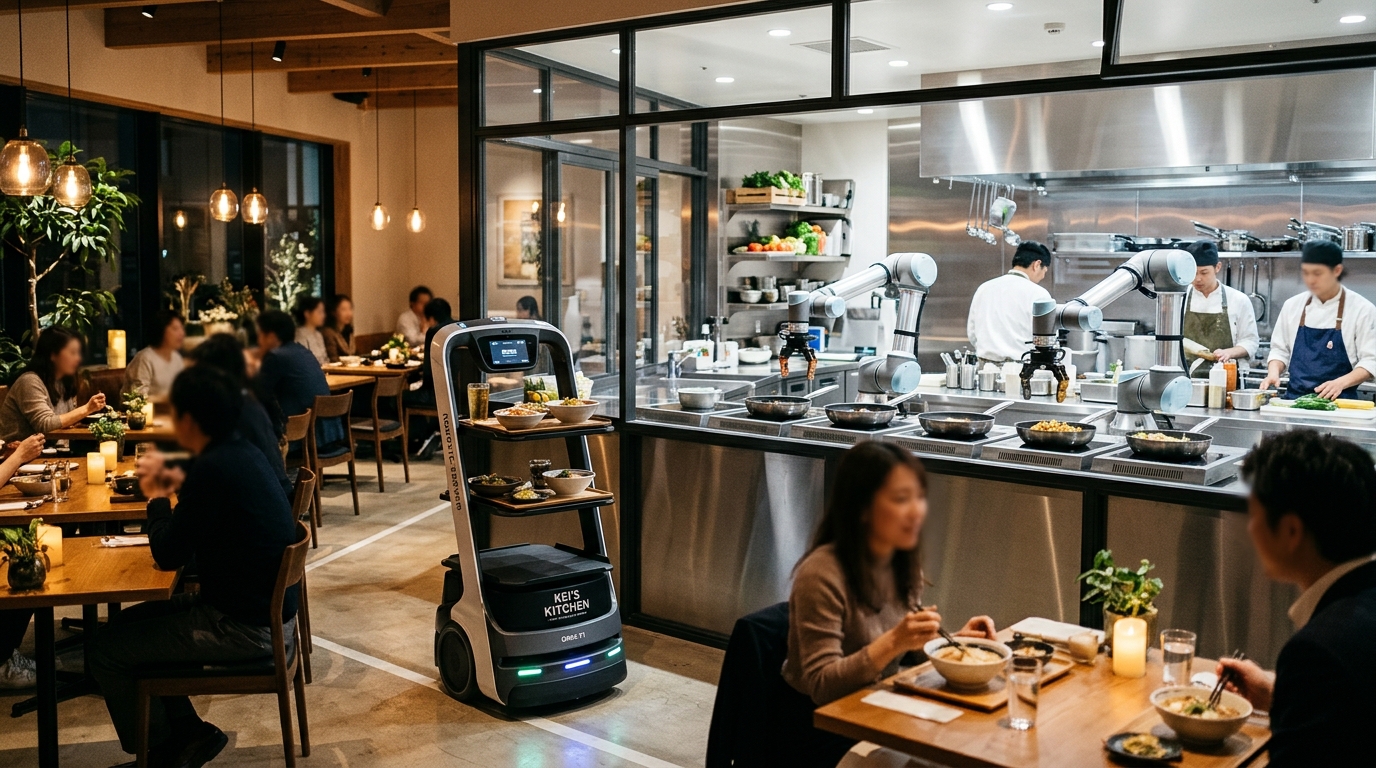
Headlines across the technology and food worlds have recently latched onto a seductive narrative: machines that never clock out.
From humanoid robots deployed in unedited 24-hour retail livestreams to glass-enclosed robotic kitchens producing hundreds of fresh dishes an hour, venture capital and automation vendors promise a friction-free hospitality paradise: no sick leave, no overtime premiums, no bad moods, and zero kitchen downtime.
For restaurant owners, café operators, and food service entrepreneurs battling Europe’s brutal labor squeeze (Personalmangel) and soaring minimum wage floors, the idea of an autonomous kitchen line sounds like salvation.
Yet anyone who has ever run a commercial kitchen during a peak Friday dinner rush knows that hospitality is not a sterile manufacturing line.
It is an unpredictable, sensory, high-heat environment governed by spilled sauces, narrow aisles, screaming toddlers, and diners demanding personalized substitutions. When polished marketing demonstrations collide with the oily reality of commercial kitchens, where does genuine operational efficiency end, and where does expensive tech theatre begin?
The myth that an autonomous robotic arm will peel your onions, dice seasonal vegetables, taste sauces on the fly, and craft bespoke artisanal dishes.
Commercial cooking robots are precision thermal finishing systems: taking pre-cut, pre-weighed, refrigerated ingredients and searing them in standardized induction cycles.
1. The German Ground Truth: Düsseldorf, Leipzig, and the Viral AGIBOT Stunt
To understand where restaurant robotics stands today, we must look beyond theoretical social media clips and examine the real systems operating in Germany right now alongside the global headlines driving public curiosity.
The Humanoid Illusion: Why AGIBOT and Bipedal Stunts Distort Hospitality Reality
A major reason restaurant automation dominates public discussion is the spectacle of humanoid robotics. High-profile demonstrations—most notably by Chinese embodied AI developer AGIBOT (founded by former Huawei engineer Peng Zhihui / Zhihui Jun)—have convinced many that bipedal androids are about to enter commercial kitchens.
In a viral test titled “Robots Never Clock Out”, AGIBOT deployed six of its G2 humanoid robots into an active Shanghai convenience store for a continuous 24-hour shift, having them brew espresso, heat pre-packaged meals, restock shelves, and clear trash across day and night cycles.
- The Seductive Fantasy: Watching human-shaped bipeds navigate aisles and hand customers a beverage creates the illusion that general-purpose androids can replace line cooks and bussers tomorrow.
- The Engineering Reality Check: An unedited review of continuous operation reveals the physical bottlenecks: high task failure rates, sluggish grip cycles (taking up to 90 seconds to grasp a single paper cup), and frequent remote teleoperation interventions to recover from balance stalls.
- The CapEx Absurdity: Deploying a €50,000+ articulated biped with 40+ degrees of freedom to carry a bowl of soup is the most inefficient mechanical design imaginable. A €9,000 wheeled tray-runner carries four times the payload at one-fifth the cost with zero tip-over risk.
While humanoids generate massive social media engagement, European food automation is advancing through far more pragmatic, purpose-built architectures.
Pilot A: Circus Group CA-1 at REWE Center Düsseldorf-Heerdt
In late 2025, German AI food-tech enterprise Circus Group partnered with supermarket giant REWE to deploy the world’s first fully autonomous in-store culinary robot, the CA-1 (Series 4), in Düsseldorf-Heerdt.
Operating within an enclosed glass footprint of just seven square meters, customers select dishes at a digital kiosk. Behind the safety glass, mechanical arms access up to 36 refrigerated ingredient silos, simultaneously cooking, roasting, and dispensing freshly made bowls, curries, and pasta dishes before cleaning their own pans.
Pilot B: ROBYN’S at Leipzig Hauptbahnhof (Powered by goodBytz)
In September 2026, Germany’s first fully autonomous station restaurant, ROBYN’S, opened inside Leipzig Hauptbahnhof. The culinary engine powering this operation was developed by Hamburg-based goodBytz, alongside Swiss robotic barista startup Smyze.
Equipped with eight induction cooktops, the system churns out between 80 and 120 hot meals per hour, cooking dishes such as Teriyaki udon, Strozzapretti Bolognese, and Kaiserschmarrn in under ten minutes with gram-level precision.
The Uncomfortable Reality: “Finishing” vs. “Cooking”
When observers watch these machines run, there is a tendency to marvel at the robotic arms picking up pans. But an engineering audit reveals the critical structural bottleneck:
- The Robot Is Not a Prep Cook: No robotic system in Düsseldorf or Leipzig is peeling garlic, washing leafy greens, cubing raw chicken breast, or slicing ripe tomatoes.
- The Central Kitchen Pre-Requisite: Every gram of food inside the silos must be washed, trimmed, precisely chopped to millimeter tolerances, and sealed into standardized cartridges in an off-site commissary kitchen or prep station.
- The Thermal Finishing Engine: The robot’s role is strictly thermal execution—dosing calibrated volumes, controlling induction temperature profiles, and executing stirring motions.
If your restaurant’s biggest operational drain is the three hours of morning knife work required to prep fresh stock, a cooking robot does not solve your problem. It merely automates the final five minutes of heat transfer.
2. The Culinary Dilemma: Calibrated Sustenance vs. The Chef’s Intuition
This engineering division brings us to the core dilemma of food robotics: the gap between nutritional consistency and culinary soul.
Consider the everyday interactions between a human guest and a line cook:
- “Can you make the sauce slightly less spicy?”
- “Please leave the cheese on the grill an extra thirty seconds so it gets crispy edges.”
- “I love extra garlic, but easy on the salt.”
A human chef cooks with senses: smelling caramelized onions, tasting sauce acidity, feeling steak elasticity with tongs, and adjusting heat when a batch of fresh tomatoes happens to be more watery than yesterday’s shipment.
Human Line Chef
✓Dynamic sensory feedback: Real-time tasting, smelling aroma, and assessing sauce reduction.
✓Spontaneous customization: Easy accommodation of "less spicy", "extra garlic", or "crispy edges".
✓Emotional connection: Crafts restaurant culinary identity and guest hospitality.
✗Human limits: Vulnerable to fatigue, shift burnout, and inconsistency during Friday rushes.
Autonomous Cooking Cell
✓100% Volumetric consistency: Meal #120 is identical to meal #1 in weight, temp, and sauce ratio.
✓Tireless throughput: Operates 20 hours a day with zero shift premiums or overtime fatigue.
✗Rigid thermal loop: Cannot taste acidity, adjust seasoning, or compensate for watery tomatoes.
✗Zero culinary flexibility: Strictly unable to accommodate spontaneous off-menu requests.
A cooking robot follows a deterministic state machine. If step 14 specifies dosing 15 ml of soy reduction and simmering at 140°C for 90 seconds, it will execute that exact command whether the room temperature is 18°C or 35°C.
The Value Equation: What Diners Are Actually Willing to Pay For
Does the food taste good? In both Düsseldorf and Leipzig, customer reviews confirm the dishes are flavorful and hot. Startups like goodBytz employ Michelin-pedigreed chefs to optimize recipes specifically for induction physics and automated reduction times.
However, there is a fundamental ceiling on pricing power:
- Customers happily pay €7 to €12 for a fast, piping-hot noodle bowl or curry at a railway terminal or cafeteria where the primary objective is rapid, reliable sustenance between train connections.
- No customer will pay a €35 to €60 fine-dining premium for an algorithmically finished dish stripped of artisanal variance, plated by a mechanical gripper, and handed across an acrylic barrier.
Robotic cooking is the ultimate weapon for high-throughput convenience food. It is entirely unsuited for experiential gastronomy.
3. The Three Categories of Gastronomy Robotics Operating Today
Before deciding whether automation belongs in your venue, you must categorize the machines by what they physically achieve. Modern food service robotics divides cleanly into three operational tiers:
Service & Bussing Runners
Autonomous mobile robots equipped with stacked trays, LiDAR, and obstacle sensors that navigate between kitchen pass and customer tables.
✓Leading Providers: Pudu Robotics (BellaBot, KettyBot), Keenon Robotics (DINERBOT), LG CLOi.
✓Primary Function: Hauling 30–40 kg of loaded food trays and bussing dirty dish racks to the dish pit.
✓Readiness Level: TRL 9 (Commercially mature, over 70,000 units running globally).
Autonomous Cooking Cells
Enclosed architectural kiosks with integrated refrigeration, volumetric dosing pumps, automated induction cookware, and self-cleaning sanitization.
✓Leading Providers: goodBytz (Germany), Circus Group CA-1 (Germany), Miso Robotics (Flippy - US).
✓Primary Function: Producing 60–120 standardized bowls, pasta, or wok dishes/hour without a line cook.
✓Readiness Level: TRL 7–8 (Expanding rapidly across transit hubs and canteens).
Deep Dive: Why Pudu’s BellaBot Became the Global Face of Restaurant Robotics
Of all commercial restaurant robots, Shenzhen-based Pudu Robotics achieved the largest footprint with BellaBot. With over 70,000 units active globally, BellaBot is the cat-faced mobile tray-runner visible across German bowling centers, Asian hotpot restaurants, and hotel breakfast buffets.
- The Cat-Face HMI Psychology: Pudu deliberately avoided industrial or humanoid aesthetics. BellaBot features animated cat eyes on an OLED screen, meows when pet on its touch-sensitive ears, and tells diners: “Your meal has arrived! Please do not pat my ears too long, I have work to do!”
- The Operational Value: This whimsical HMI disarms diners, turning what could feel like cold industrial automation into playful entertainment, especially for families and children.
- The Hardware Architecture: BellaBot packs 4 height-adjustable trays (carrying up to 40 kg total), dual 3D omnidirectional sensors, and LiDAR SLAM navigation that recalculates routes around chair legs and moving patrons at up to 1.2 m/s.
Category 3: Robotic Baristas & Beverage Mixologists
The third emerging segment focuses strictly on automated liquids. Systems like Switzerland’s Smyze, Estonia’s Yanu, or Richtech’s ADAM deploy collaborative 6-axis arms behind clear kiosks:
- The Workflow: Grinding beans, tamping espresso pucks, steaming milk with customized foam density, drawing latte art, and pouring craft mocktails or bubble tea.
- The Use Case: Ideal for high-density commuter hubs and 24/7 hotel lobbies where high-margin coffee and drink revenue can be captured during the dead hours between 22:00 and 06:00 without staffing an overnight barista.
4. The CapEx Ledger: True Costs, Leases, and Real-World ROI
When sales representatives pitch hospitality robotics, they frequently compare a robot’s monthly lease directly against a full-time employee’s gross salary.
In Germany, where fully burdened restaurant staff cost between €2,800 and €3,800 per month (factoring employer contributions, holiday pay, and sick leave replacement), saving “one full position” appears to justify any machine.
In reality, robots rarely eliminate human staff 1:1. They alter labor distribution. Here is what the genuine balance sheet looks like:
1. Front-of-House Service Runners (e.g., Pudu BellaBot, Keenon DINERBOT)
- Direct Hardware Purchase: €8,500 – €14,000 per robot (depending on sensor package and multi-floor elevator integration).
- Robotics-as-a-Service (RaaS) Lease: €450 – €800 / month on 24- to 36-month contracts (inclusive of maintenance, cloud navigation updates, and motor warranties).
- The Operational Payoff: The robot does not replace your waiter—it becomes your waiter’s pack mule.
- A server in a 200-seat restaurant walks between 10 and 15 kilometers per shift, spending up to 45% of their time carrying heavy ceramic plates back and forth between kitchen and table.
- Offloading plate transport to a runner robot allows a team of three floor servers to handle the table volume of five. Server fatigue drops, drop-and-shatter accidents decline, and waitstaff remain on the floor where they can upsell desserts, refill drinks, and generate tips.
- Payback Period: 6 to 10 months for large-footprint venues (buffets, beer halls, family restaurants).
-12 km / Shift
Average daily walking distance eliminated per server when tray-runners handle the kitchen-to-floor transit.
2. Autonomous Cooking Kiosks (e.g., Circus CA-1, goodBytz)
- Turnkey System CapEx: €90,000 – €250,000+ (depending on the number of cooking stations, internal refrigeration volume, and self-cleaning plumbing tie-ins).
- Software & Recipe Maintenance: €1,200 – €2,400 / month for cloud telemetry, AI inventory forecasting, HACCP compliance logging, and system firmware.
- The Operational Payoff: The business case is strictly volumetric. Because the cell can operate 20 hours a day without shift premiums or fatigue, it excels in captive transit hubs (railway stations, highway rest stops, university canteens).
- Payback Period: 2.5 to 4 years, but only if the unit maintains a throughput exceeding 250 to 350 meals per day. Below that volume, the capital depreciation and cartridge refilling overhead overwhelm your margin.
5. The Gastronomy Fit Matrix: Which German Dining Concepts Actually Benefit?
Germany hosts roughly 160,000 gastronomic enterprises, spanning everything from century-old Bavarian Brauhäuser to fast-casual bowl bars, artisan espresso shops, and local Currywurst kiosks.
Where does robotics make financial sense, and where is it a disastrous misallocation of capital?
Systemgastronomie, Train Stations, Airports & Canteens
Concepts modeled on standardized, modular menus (bowls, pasta, wok dishes, burgers) where customers prioritize rapid turnover (<5 min wait), digital ordering, and consistent pricing.
Beer Gardens, Brauhäuser & Family Buffets
Venues with sprawling dining areas (150–400 seats) where carrying five heavy 1-liter Maß beers and cast-iron pork knuckle platters over 80 meters destroys server stamina.
Artisan Bakeries, Donut Chains & Traditional Currywurst/Döner Kiosks
Small-footprint (20–60 m²) venues where operations are fundamentally counter-service. In a donut shop (e.g., Royal Donuts, Dunkin'), inventory is baked off-site or in morning batches; paying €600/month for a robot to hand a pastry across a counter is financial waste. In a Currywurst or Döner imbiss, a €600 commercial rotary sausage slicer or vertical kebab cutter achieves 90% of the labor savings of a €150,000 robot arm at 0.5% of the CapEx.
Artisanal Restaurants & Fine Dining
Venues where dining is an emotional, sensorial ritual. Guests visit specifically for the chef’s craft, the sommelier’s wine pairing, and human hospitality. A blinking plastic robot tray ruins the atmosphere.
6. The Uncomfortable Friction: Errors, Hygiene, Privacy, and Customer Psychology
Installing a robotic fleet is not merely a software deployment; it is a live social experiment conducted in a crowded room full of paying customers.
Hospitality operators who ignore the operational edge cases quickly discover four major friction points:
1. What Happens When the Machine Fails?
When a human waiter is having a rough day, drops a fork, or behaves abruptly, customer psychology is predictable: the guest complains to the restaurant manager. The manager steps in, apologizes, comps an espresso or glass of Grappa, and preserves the customer relationship.
What happens when a robot errs?
- A tray-runner robot’s path planner gets confused by an unmapped baby stroller, locks its brakes abruptly, and sends a hot bowl of tomato soup sliding across a guest’s coat.
- A robot cannot apologize, gauge embarrassment, or de-escalate tension. It simply flashes error code
E-304: Path Obstructedand beeps rhythmically. - The restaurant manager still has to leave their desk, defuse an infuriated guest, wipe down the floor, and issue a refund. The presence of the machine does not eliminate human conflict; it changes the nature of the escalation.
2. The Commercial Kitchen Grease Trap: Sensor Blindness
Industrial warehouses are clean, dry, climate-controlled environments. Commercial kitchens are filled with aerosolized cooking oils, steam, flour dust, and fluctuating temperatures.
LiDAR sensors, RGB-D stereocameras, and ultrasonic transceivers rely on crystal-clear optical surfaces. Within four hours of active deep-frying or wok-searing, an airborne oil mist coats optical lenses.
- If staff do not follow disciplined, twice-daily cleaning protocols with optical-safe degreasers, the robot begins detecting “phantom obstacles.”
- It freezes in the middle of clear walkways, refusing to move because its grease-smeared lens interprets diffused ambient light as an imminent collision.
3. The German Privacy & Data Conundrum (DSGVO / GDPR)
Modern mobile service robots navigate using Simultaneous Localization and Mapping (SLAM), utilizing real-time cameras and 3D LiDAR sensors constantly scanning at knee and table height.
In Germany and across the EU, diners are exceptionally sensitive to surveillance. When a camera-equipped machine pauses next to a private booth where two business partners are reviewing contracts or a couple is having an intimate dinner, discomfort is immediate:
- Are these cameras recording?
- Is video telemetry streaming to a cloud server in Shenzhen or California?
- Does the robot violate DIN EN ISO standards or GDPR privacy rules?
To deploy legally and socially in Europe, restaurants must mandate on-premise edge processing: video frames must be processed purely in volatile RAM for obstacle segmentation and instantly discarded without persistent storage or external cloud egress.
4. The Novelty Trap vs. The New Luxury: Why Human Service Commands the Future Premium
Today, restaurant robots benefit from curiosity. Parents bring their children to a pizza parlor specifically to see the cat-faced BellaBot sing “Happy Birthday” and deliver bread rolls. It generates free TikTok clips and local newspaper features.
However, novelty has a very short shelf life.
Within 24 to 36 months, as tray-runners and automated beverage kiosks become ubiquitous sights in highway service stations, transit terminals, and budget buffets, consumer perception will invert:
Robots Become the Baseline; Humans Become the Luxury
When autonomous machines handle budget dining and fast-casual fuel, human hospitality will command the highest price premium. A genuine smile, authentic empathy, tableside humor, and a waiter who remembers your favorite aperitif will become the ultimate dining status symbol.
7. Frequently Asked Questions About Restaurant Robotics
For restaurateurs, operators, and curious engineers evaluating the landscape, here are direct answers to the most common queries searched across Google and AI search engines:
Can humanoid robots like AGIBOT actually work in restaurant kitchens and cafés?
Direct Answer: No. Despite viral 24-hour retail demonstrations (such as AGIBOT's Shanghai convenience store trials), bipedal humanoids remain mechanically and economically unviable for commercial dining. Deploying a €50,000+ articulated biped with 40+ degrees of freedom to hand over a cup or carry a plate is severe engineering overkill when €9,000 wheeled tray-runners (like BellaBot) carry four times the payload with zero tip-over risk, and enclosed modular kiosks (like goodBytz) cook at ten times the speed.
How much does a Pudu BellaBot cost to buy or lease in Germany?
Direct Answer: A Pudu BellaBot costs between €8,500 and €14,000 for direct hardware purchase, or €450 to €800 per month under a standard 24- to 36-month Robotics-as-a-Service (RaaS) leasing contract. Leasing packages typically include SLAM LiDAR mapping, hardware warranties, spare parts, and remote cloud maintenance.
Can cooking robots like goodBytz or Circus CA-1 customize dishes like a human chef?
Direct Answer: No. Autonomous kitchen cells cannot make sensory or artisanal adjustments like "make the sauce slightly less spicy" or "crisp the edges an extra thirty seconds." They execute rigid, pre-programmed heating and dosing profiles using pre-cut, refrigerated ingredient cartridges. They deliver exceptional volumetric consistency, but zero sensory intuition.
What happens if a restaurant service robot spills hot food or hits a customer?
Direct Answer: Under European tort law and German civil liability (BGB § 823), the restaurant operator is primarily liable for physical accidents and property damage on their premises. Because a robot cannot apologize or offer restitution, human management must step in immediately to clean up, provide first aid if hot liquids are involved, and de-escalate customer frustration.
Do restaurant service robots actually replace human waiters?
Direct Answer: In real commercial venues, service robots do not eliminate human waiters 1:1; they act as material mules. A runner robot eliminates 10 to 15 kilometers of heavy plate-carrying per server shift, enabling three floor servers to manage the capacity of five while keeping staff on the dining floor to take orders, upsell drinks, and maintain guest relationships.
Are robot cameras in dining rooms legal under German DSGVO / GDPR privacy laws?
Direct Answer: Yes, but only if the robot processes camera streams strictly in local, volatile memory (RAM) for SLAM obstacle navigation. Under German DSGVO (GDPR), transmitting diner video feeds to external cloud servers or retaining video recordings without explicit customer consent is illegal. Operators must ensure vendor compliance with localized edge processing.
8. The Systems View: How Restaurateurs Should Approach Automation Today
If you are an operator evaluating robotics for your business, cut through the marketing noise with three practical rules:
- Automate the Ergonomics, Not the Soul: Do not buy a robot to replace the chef who creates your culinary identity or the server who connects with your regulars. Deploy runners strictly to eliminate the 12 kilometers of back-breaking tray-carrying that causes kitchen turnover.
- Standardize the Menu Before the Machine: A cooking robot cannot salvage an inconsistent supply chain. If your prep operations cannot produce millimeter-exact, standardized refrigerated ingredients every single morning, an automated kitchen cell will jam within 48 hours.
- Calculate Volume First: If your location cannot reliably sell 200+ standardized meals a day during peak windows, high-CapEx cooking kiosks are a financial liability. Stick to proven, mechanical kitchen appliances until foot traffic justifies algorithmic automation.
Deploying Automation Systems or Need Software to Direct Your Shopfloor?
Physical machines and robot arms are only as capable as the software directing them. Mintmal helps engineering teams, custom machine builders, and commercial operators build the software layer around physical automation: developing custom Python/MQTT/ROS 2 middleware, deploying edge vision for automated quality inspection, and building sovereign, on-premise data pipelines.
About Mintmal
Mintmal delivers practical AI and software systems with engineering rigor from Wuppertal, Germany. From AI telephone automation for trades to sovereign open-source systems.