Robo-Hub ProLog: How to Test Humanoid Robots in Factories Without Line Stoppages
Over 175 industrial partners and Fraunhofer IPA have launched Robo-Hub ProLog at IPAI Heilbronn. We explore how this living lab de-risks humanoid robotics for SMEs and how to run brownfield pilots without line stoppages.
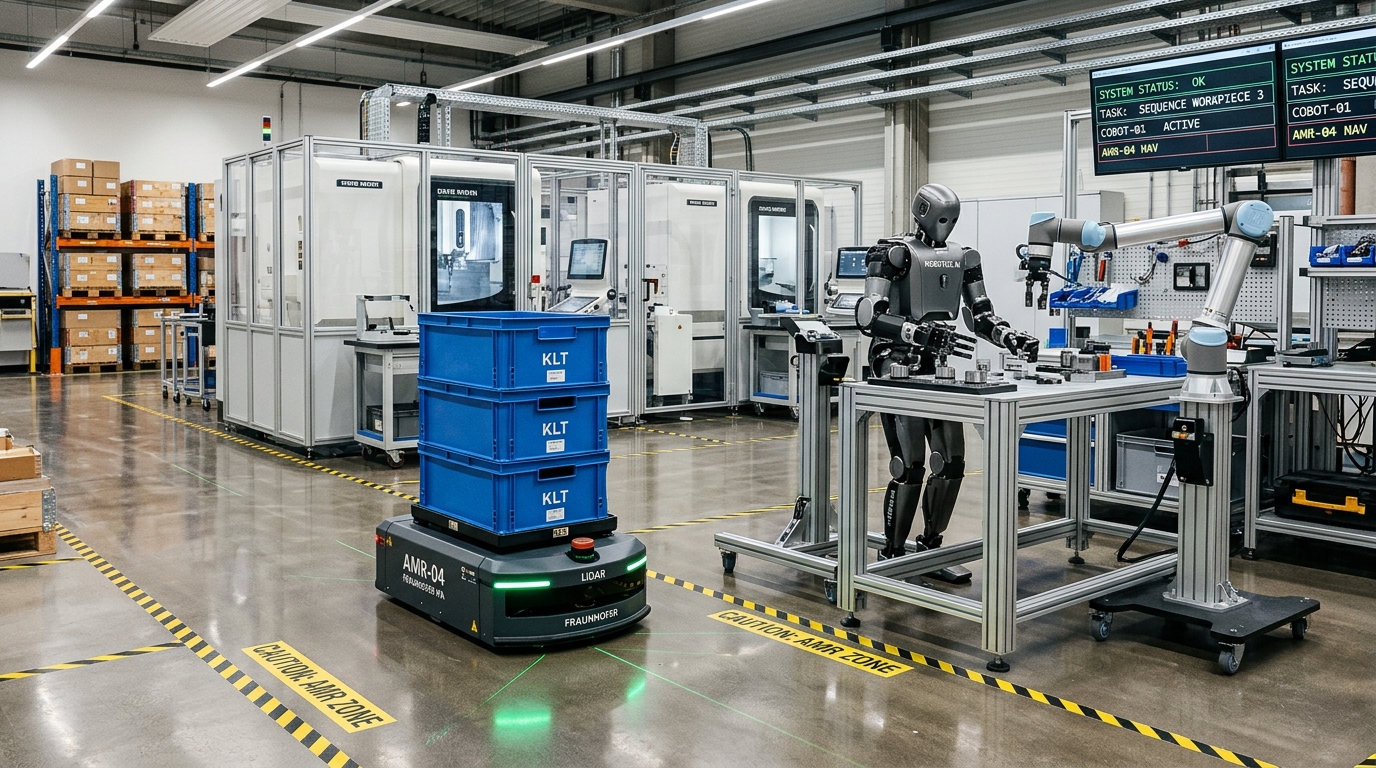
Manufacturing executives do not need another viral video of a humanoid robot doing backflips, pouring a cup of coffee, or sorting brightly colored plastic cubes in a sterile Silicon Valley laboratory.
On a production floor in Baden-Württemberg, North Rhine-Westphalia, or Ohio, physical automation is governed by an entirely different set of physical laws:
- A robotic arm or mobile manipulator that fails one out of every twenty pick-and-place cycles does not represent “promising research”—it represents an immediate line stoppage.
- In high-mix, precision manufacturing, an unplanned line halt can cost between €10,000 and €100,000 per hour in downstream idle time, missed customer delivery windows, and ruined stamping dies.
- If an experimental neural network controlling a 70-kilogram bipedal machine stumbles or commands an unpredicted actuator surge near human shift workers, it violates DIN EN ISO 13849-1 and breaches European machine safety law.
Against this backdrop, the Fraunhofer Institute for Manufacturing Engineering and Automation (Fraunhofer IPA) and its consortium partners have reached a milestone in their federal BMFTR initiative: the operational rollout of Robo-Hub “ProLog” (Autonomous Production and Logistics) at the Innovation Park Artificial Intelligence (IPAI) in Heilbronn.
Supported by €500,000 in preliminary federal funding, ProLog is not an academic think tank. It is an industrial proving ground backed by over 175 industrial partners—ranging from mid-sized custom machine builders (Sondermaschinenbau) to Tier-1 automotive suppliers and automation leaders—developed in partnership with the Karlsruhe Institute of Technology (KIT), the Institute for Control Engineering of Machine Tools and Manufacturing Units (ISW) at the University of Stuttgart, ARENA2036, and Campus Schwarzwald.
Simultaneously, Fraunhofer IPA has published its Industrial Humanoid Benchmark and Embodied AI Evaluation Framework, putting commercial platforms—including the Unitree G1—through standardized, shopfloor-grade assembly and logistics trials.
The assumption that neural Vision-Language-Action (VLA) models and commercial humanoids can be uncrated and immediately integrated into legacy shopfloor operations.
Physical AI operates probabilistically, while factory PLCs demand microsecond determinism. Without independent validation, direct plant pilots invite catastrophic downtime.
Why are 175+ manufacturing enterprises pooling resources to build a shared living lab instead of piloting robots directly on their own factory floors? Is this another layer of German bureaucratic paperwork, or is it a pragmatic survival strategy for the Mittelstand? And most importantly, how can international plant owners and machine builders adopt these testing methodologies to structure their own de-risked automation pilots?
1. The Status Quo: How Industry Handled Embodied AI Before (The “Pilot Purgatory”)
To understand why Robo-Hub ProLog was funded, one must examine how industrial enterprises have approached robotics innovation over the past five years.
Historically, industrial automation followed a strictly deterministic paradigm. If an engineer integrated a six-axis KUKA or Fanuc robot behind a light curtain, its repeatability was measured to 0.02 millimeters under ISO 9283. Its trajectory was mathematically calculated via inverse kinematics, verified in CAD simulation, hard-coded into structured logic, and monitored by a certified safety PLC via PROFIsafe or TwinSAFE. Cycle times were constant to the millisecond.
The emergence of embodied AI, vision-language-action (VLA) foundation models, and mobile manipulation upended this paradigm. These systems do not follow hard-coded Cartesian coordinates; they make probabilistic inferences based on neural network weights, live RGB-D camera feeds, and real-time sensor fusion.
Faced with massive vendor marketing campaigns, manufacturing companies typically fell into one of two traps:
An enterprise buys a commercial quadruped, collaborative arm, or prototype humanoid for €25,000 to €150,000. Because plant operations refuses to allow an uncertified, unpredictable system near the revenue-generating line, the robot is relegated to an isolated R&D corner or exhibition showroom. Engineers experiment with Python scripts under pristine lighting and clean floors.
Under executive pressure to "showcase AI on the shopfloor," a plant attempts to pilot a mobile manipulator or autonomous transport unit directly inside an active brownfield production area. The team quickly discovers that changing ambient sunlight through skylights blinds the vision model, cycle times fluctuate wildly between 1.2 seconds and 4.8 seconds, and unexpected sensor noise triggers emergency stops that halt upstream stamping presses.
This dynamic created what automation directors call “Pilot Purgatory”: dozens of disconnected proofs-of-concept, zero commercial production rollouts, and mounting CapEx write-offs.
Industry lacked a neutral, rigorous, and isolated intermediate environment: an industrial “living lab” where embodied AI could be subjected to real shopfloor grime, brownfield spatial constraints, and non-stop operational stress without risking commercial manufacturing downtime.
2. The Economic & Industrial Drivers: Why the Mittelstand Is Moving Now
The timing of the Robo-Hub ProLog initiative is not accidental. German and European manufacturing is experiencing an intense structural squeeze driven by three converging macro forces:
Driver 1: Shift-Work Wage Escalation and Demographic Atrophy
While economic headlines often discuss macroeconomic layoffs, the shopfloor reality tells a different story. In Western Europe, fully burdened factory shift labor—incorporating pension contributions, health coverage, vacation accrual, night-shift premiums, and sick leave—costs between €45 and €65 per hour.
Paying €55/hour for an operator to manually push a handcart or walk 15 kilometers per night shifting plastic small load carriers (Kleinladungsträger or KLT boxes) between stamping cells erodes operating margins. More critically, the Fachkräftemangel (skilled labor shortage) is an acute demographic reality: the generation of experienced mechatronics technicians and machine operators is retiring, and younger workers are unwilling to work physical third shifts in noisy environments. Automation is no longer an optimization exercise; it is an operational continuity requirement.
Driver 2: The Brownfield Constraint
Silicon Valley robotics pitch decks invariably display sparkling, wide-aisle, greenfield warehouses built specifically for autonomous mobile robots (AMRs).
The German Mittelstand, however, operates inside brownfield facilities built over decades. A typical plant in the Swabian Alps or Westphalia features 2.5-meter aisles, varying floor concrete qualities, heavy fire doors, legacy hydraulic presses, manual forklift traffic, and overhead crane zones. Ripping up concrete to install fixed roller conveyors or automated storage and retrieval systems (ASRS) costs millions of euros and requires multi-month plant shutdowns that would bankrupt a mid-sized supplier.
The requirement is clear: automation must adapt to the existing factory layout, not the other way around.
Driver 3: The Threat of Asian Hardware Dominance
Chinese robotics OEMs (such as Unitree, AgiBot, and specialized AMR manufacturers) are iterating at breakneck speed, backed by massive domestic supply chains and low bill-of-materials (BOM) costs. A research-grade bipedal humanoid like the Unitree G1 entered the market at roughly $16,000—a fraction of the cost of Western alternatives.
However, low purchase prices do not equal industrial deployability. European manufacturers cannot simply unbox a foreign robot and set it loose in a factory. To operate lawfully, the equipment must satisfy strict European Union safety directives, industrial cybersecurity standards, and machine CE-marking protocols.
The Mittelstand needed a way to separate viable commercial hardware from unverified marketing claims—auditing what low-cost platforms can actually do when subjected to standardized industrial tasks.
175+ Partners
Industrial enterprises backing Robo-Hub ProLog at IPAI Heilbronn to de-risk embodied AI CapEx
3. Deconstructing the Living Lab: What Robo-Hub ProLog Actually Evaluates
Located at the Innovation Park Artificial Intelligence (IPAI) in Heilbronn, Robo-Hub ProLog functions as a vendor-neutral physical testbed. Rather than testing software in idealized simulation environments (which consistently suffer from the “Sim-to-Real” transfer gap), ProLog reproduces the mechanical, optical, and logistical friction of an active production hall.
The living lab evaluates three interconnected automation layers:
Robo-Hub ProLog Living Lab
A vendor-neutral proving ground filtering physical AI through three synchronized testing streams before factory floor deployment:
Zero commercial line stoppages • Predictable Takt times • Audited CE machine conformity
The Fraunhofer Humanoid Industrial Benchmark Under the Hood
In parallel with the physical hub, Fraunhofer IPA released its Industrial Humanoid Benchmark, an objective testing framework designed to evaluate whether bipedal and mobile manipulation platforms can perform real work in manufacturing cells.
When Fraunhofer audited platforms like the Unitree G1 in industrial assembly contexts, they evaluated four rigorous shopfloor readiness criteria:
Center-of-Mass Invariance Under Acceleration
Evaluating whether a robot can manipulate a 3 kg to 10 kg workpiece without shifting its center of gravity enough to trigger instability or joint torque saturation. Testing evaluates dynamic gripper retention when encountering sudden inertial changes (e.g. emergency braking or uneven floor seams).
Eliminating Probabilistic Stuttering
Measuring the statistical variance ($\sigma$) of end-to-end vision-language-action inference loops. If an AI policy requires 900 ms on one cycle and 4,500 ms on the next because an optical shadow confused the feature extractor, the robot cannot be synchronized with an upstream indexing table or conveyor.
Air-Gapped Packet Inspection
Sniffing every inbound and outbound network socket on the robot controller. Does the robot require an active cloud connection to resolve inverse kinematics or update its policy? Does it transmit raw LiDAR point clouds, camera feeds, or factory CAD drawings to overseas servers?
ISO/TS 15066 & Force-Torque Validation
Testing physical collision behaviors using bio-fidelic pressure sensors to verify that transient and quasi-static contact forces remain well below pain and injury thresholds across all human body regions, even when the AI makes an unexpected movement.
4. The Multi-Departmental Impact: How ProLog Alters the Enterprise Landscape
The transition from isolated robotics trials to certified living-lab validation does not merely affect the R&D department. It sends ripples across the entire industrial organization:
Robotics OEMs & Component Suppliers
Supply SideThe era of selling robots via stylized videos is ending. European machine builders are demanding verifiable Fraunhofer benchmark scores, documented Mean Time Between Failures (MTBF), open ROS 2 / OPC UA interfaces, and transparent bill-of-materials declarations before issuing purchase orders.
Custom Machine Builders (Sondermaschinenbau)
IntegratorsSondermaschinenbauer operate on fixed-price delivery contracts. If an integrated mobile robot fails to perform during final factory acceptance testing (FAT), the builder absorbs the liquidated damages. ProLog allows builders to pre-qualify multi-vendor automation concepts in a neutral setting before committing to customer SLAs.
Plant Operations & Shift Supervisors
Shopfloor ExecutionInstead of receiving unverified technology dumped onto their lines by executive fiat, operations teams receive validated standard operating procedures (SOPs), predictable takt-time guarantees, and clear recovery routines for when a robot encounters an anomaly.
Compliance, Safety Officers & Legal Counsel
Governance & RiskSafety engineers gain audited documentation to support their CE risk assessments under the Machinery Directive. Crucially, this prepares enterprises for the impending EU Machinery Regulation (EU) 2023/1230, which introduces explicit legal requirements for self-evolving and AI-driven machine behaviors.
IT & OT Cybersecurity Teams
InfrastructureUnder the EU NIS 2 Directive and IEC 62443 standards, plant networks must be segmented. Living lab test protocols provide verified network architectures that isolate probabilistic AI controllers from deterministic safety PLCs while maintaining air-gapped data boundaries.
5. Global Geopolitics & Testbed Comparison: How Europe Compares to the US and China
Is Germany’s Robo-Hub ProLog unique, or are other manufacturing powerhouses building equivalent testbeds?
Around the world, three distinct models for validating physical AI and industrial robotics have emerged:
| Dimension | United States (ARM / NIST) | China (Embodied AI Centers) | Germany (ProLog / Fraunhofer) |
|---|---|---|---|
| Primary Driver | Aerospace, Defense (DoD), and Venture-backed commercialization | Mass hardware scaling, domestic supply-chain velocity, state subsidies | Precision manufacturing, brownfield SME intralogistics, export compliance |
| Core Anchor | ARM Institute (Pittsburgh), NIST Test Facilities | Shanghai & Beijing Embodied AI Robotics Innovation Centers | Robo-Hub ProLog (IPAI Heilbronn), Fraunhofer IPA, ARENA2036 |
| Testing Philosophy | Software-first: rapid algorithmic iteration, simulation, dual-use applications | Hardware-first: aggressive factory trial-and-error in consumer electronics & EV lines | Systems engineering: deterministic fieldbus integration, functional safety, CE-marking |
| Regulatory Focus | OSHA standards, ANSI/RIA R15.06, voluntary safety guidelines | National standards (GB), rapid regional operational piloting | EU Machinery Regulation 2023/1230, ISO 13849 (PL d/e), EU AI Act High-Risk |
| Target Ecosystem | Tier-1 defense contractors, hyperscalers, tech startups | Mega-factories, high-volume consumer goods, domestic robotics OEMs | High-mix, low-volume Mittelstand, custom machine builders, Tier-1/2 suppliers |
Does This Give European Machine Builders an Export Advantage?
A common criticism of European industrial policy is that regulation stifles speed. However, in the high-stakes world of capital machinery exports, the opposite dynamic frequently plays out.
German and European machine builders export between 70% and 85% of their production machinery to international markets, including the United States, China, and Southeast Asia. Global industrial buyers—whether an automotive plant in Spartanburg, South Carolina, or a semiconductor facility in Penang—purchase European machinery specifically because it complies with the world’s most rigorous functional safety and build-quality standards.
If an automation system or embodied AI cell passes the Fraunhofer Industrial Benchmark and fulfills the EU Machinery Regulation:
- Universal Deployability: It can be exported and operated anywhere in the world without requiring safety retrofits or incurring insurance liabilities.
- Import Barrier for Low-Quality Hardware: Foreign robotics manufacturers cannot simply dump uncertified hardware into the European market. If a robot cannot prove deterministic safety separation, air-gapped data compliance, and verifiable force limits, it cannot legally carry the CE mark.
Rather than being a competitive handicap, rigorous European testbed certification functions as a commercial trust anchor in the international marketplace.
6. Bureaucratic Burden or Practical Shield? Answering the Skeptics
Whenever a German federal ministry (BMFTR) funds an industrial initiative involving Fraunhofer institutes and university consortia, experienced plant managers rightly ask:
“Is this just another taxpayer-funded academic exercise where researchers produce 100-page whitepapers while Chinese factories deploy 10,000 robots?”
This skepticism is healthy and historically justified. Germany has often suffered from the “academic innovation paradox”: generating world-class engineering research that gets commercialized by American software giants or scaled by Chinese hardware conglomerates.
However, an analysis of Robo-Hub ProLog’s operational structure reveals key differences:
175+ Industrial Stakeholders Are Not Academics
Academic paper mills are sustained by university doctoral candidates. ProLog is backed by 175 commercial manufacturing enterprises that volunteered their engineering time, hardware, and operational requirements. Machine builders do not sit on industrial advisory boards to read theoretical papers; they participate to solve acute shopfloor bottlenecks.
A Shared Due-Diligence Syndicate for the Mittelstand
A multi-billion-dollar enterprise like BMW or Amazon can afford to buy 50 experimental robots, discover that 30 of them are unusable, and write off the €5 million loss as R&D. An owner-operated *Mittelstand* company with 300 employees and €45 million in annual revenue cannot. For an SME, an unviable €350,000 automation investment wipes out a significant percentage of annual operating margin. ProLog acts as a shared risk-pooling syndicate: the consortium tests the hardware and software so individual SMEs do not have to gamble their balance sheets.
Auditing Off-the-Shelf Commercial Robots (e.g. Unitree G1)
Fraunhofer IPA did not build a theoretical research robot in isolation. They acquired commercial, off-the-shelf platforms—including the Unitree G1—and subjected them to practical manufacturing assembly routines. This provides plant managers with empirical data on real-world payload stability, thermal degradation, and cycle-time consistency.
7. The Workforce Factor: Qualification and the Dual Education Model
A recurring misconception in the media is that embodied AI and humanoid robots are intended to abruptly replace skilled manufacturing workers.
On the shopfloor, the reality is the exact opposite: physical robots are useless without qualified humans to supervise, commission, and maintain them.
When a mobile manipulator stalls because a pallet was placed 50 millimeters out of position, who troubleshoots the system? A remote machine learning researcher in a central office cannot diagnose whether the issue is a dirty camera lens, a jammed pneumatic gripper, or an Ethernet communication drop on an industrial fieldbus.
This requires shopfloor personnel who understand both mechanical machinery and modern software interfaces:
The Dual Vocational Advantage (Duale Ausbildung)
Germany's established apprenticeship system (IHK/HWK) trains mechatronics technicians (*Mechatroniker*) who possess deep hands-on expertise in hydraulics, mechanics, electrical wiring, and PLC logic. ProLog serves as an educational bridge—developing qualification curricula to upgrade these technicians into Shopfloor Robotics & AI Integration Specialists.
Ergonomic Relief Over Worker Displacement
Early physical AI deployments focus on ergonomically destructive tasks: moving 15 kg brake disc containers, bending into wire-mesh stillages (*Gitterboxen*), and walking long distances across concrete floors during third shifts. Relieving operators from repetitive physical strain reduces chronic sick leave while shifting workers into higher-value setup and supervisory tasks.
The Operational Risk: The "Black Box" Backlash
If an automation team introduces an opaque AI system without training shopfloor operators, workers will view the machine with suspicion. When it stumbles, they will switch it off and revert to manual labor. Qualification and intuitive diagnostic interfaces are essential prerequisites for shopfloor acceptance.
8. Rollout Timeline: When Does This Become Practical Reality?
Understanding the industrial adoption roadmap is vital for CapEx planning. Physical AI integration will not happen overnight; it is advancing through three distinct operational phases:
Establishment of physical proving grounds at IPAI Heilbronn and preliminary €500,000 BMFTR milestone validation.
Fraunhofer Humanoid Benchmark release, commercial hardware trials (Unitree G1), and heterogeneous fleet dispatching.
Consortium partner shopfloor rollouts and full applicability of the binding EU Machinery Regulation 2023/1230.
Key Milestones on the Horizon:
- Current Status (2025–2026): ProLog has achieved its initial federal milestone at IPAI Heilbronn, establishing the physical testbed and releasing the Fraunhofer Humanoid Industrial Benchmark. Consortium partners are running controlled evaluations across mobile manipulation and intralogistics tasks.
- The Regulatory Turning Point (January 20, 2027): On this date, the EU Machinery Regulation (EU) 2023/1230 becomes universally and legally binding across all EU member states, replacing the legacy Machinery Directive 2006/42/EC. Any manufacturer or integrator deploying autonomous, self-learning, or AI-directed machines must provide formal conformity assessments covering dynamic risk analysis and cybersecurity resilience.
- Commercial SME Adoption (2027–2029): Validated mobile manipulators and wheeled hybrid robots begin entering brownfield Mittelstand production cells for targeted tasks: machine tending, bin picking, and automated tote transport.
9. The Mintmal Strategic Blueprint: Structuring On-Site SME Pilots Without Line Stoppages
Plant owners and engineering directors do not need to wait until 2027 or travel to Heilbronn to begin de-risking automation. By adopting the testing principles pioneered in living labs like ProLog, any manufacturing facility can structure its own on-site pilot.
Below is Mintmal’s 4-stage architectural blueprint for validating embodied AI and autonomous intralogistics without risking a single minute of commercial line downtime:
Build a Non-Interfering Parallel Buffer Loop
Never introduce an experimental robot directly into the primary production stream. Instead, identify an offline buffer area or parallel staging loop—such as secondary packaging, empty tote return, or intermediate staging between machining cells. If the robotic pilot halts, human operators or manual tuggers continue normal production without interference.
Never Run AI Logic Inside the Safety PLC
Enforce strict architectural separation between the probabilistic AI perception layer and the deterministic safety-integrated control layer:
Bridge Robots to PLCs via ROS 2, MQTT & OPC UA
Avoid closed, proprietary vendor software that locks your plant into a single robot brand. Build an open software middleware layer using ROS 2, MQTT, and OPC UA. This enables your fleet manager to exchange standardized job orders, container IDs, and station states with your existing PLC and Manufacturing Execution System (MES).
Measure Variance Before Commercial Deployment
Before signing off on final line integration, run a rigorous 1,000-cycle continuous stress test inside the shadow cell under varying real-world conditions: morning lighting, evening shadows, simulated dust on optical lenses, and slightly misaligned containers. Measure cycle-time standard deviation ($\sigma$) and thermal stability.
Deploying Automation Systems or Need Software to Direct Your Shopfloor?
Physical machines and robot arms are only as capable as the software directing them. Mintmal helps engineering teams, custom machine builders, and industrial plants build the software layer around physical automation: developing custom Python/MQTT/ROS 2 middleware, deploying edge vision for automated quality inspection, and building sovereign, on-premise data pipelines.
10. Conclusion: The Living Lab as a Strategic Competitive Moat
The establishment of Robo-Hub ProLog at IPAI Heilbronn and the release of Fraunhofer IPA’s Humanoid Industrial Benchmark represent a structural shift in how European industry approaches embodied AI.
For the past five years, the global robotics conversation has been dominated by venture-backed hype, slick video demos, and the seductive promise that artificial general intelligence would effortlessly inhabit mechanical bodies and solve factory labor shortages overnight.
The German Mittelstand, with 175+ industrial partners stepping up to co-fund and steer ProLog, has delivered a characteristically pragmatic rebuttal:
- Physical AI cannot be deployed on faith. It must be measured, benchmarked, stress-tested, and audited against the harsh mechanical realities of brownfield manufacturing.
- Deterministic safety is non-negotiable. Neural models will direct high-level perception and trajectory adaptation, but certified safety PLCs, fieldbus boundaries, and the EU Machinery Regulation will continue to enforce the physical limits of speed, force, and separation.
- The winners of this automation transition will not be the companies that buy the most hyped hardware. They will be the machine builders and plant owners who master the software middleware layer—building sovereign, open, and robust digital architectures that connect physical robots to the industrial control systems already running their factories.
By treating embodied AI as an empirical engineering discipline rather than a venture marketing spectacle, European manufacturing is not falling behind. It is building the foundation to deploy physical AI safely, reliably, and profitably where it matters most: on the real factory floor.

About Mintmal
Mintmal delivers practical AI and software systems with engineering rigor from Wuppertal, Germany. From AI telephone automation for trades to sovereign open-source systems.