Humanoid Robots: Hype vs. Factory Reality & The Over-Automation Trap
Silicon Valley promises millions of humanoid robots replacing factory workers and domestic staff. We dissect the mechanical bottleneck of the 22-DoF hand, the hard lesson of Tesla's 2018 tent, why AMRs still dominate, and what can actually run on the shopfloor by 2027.
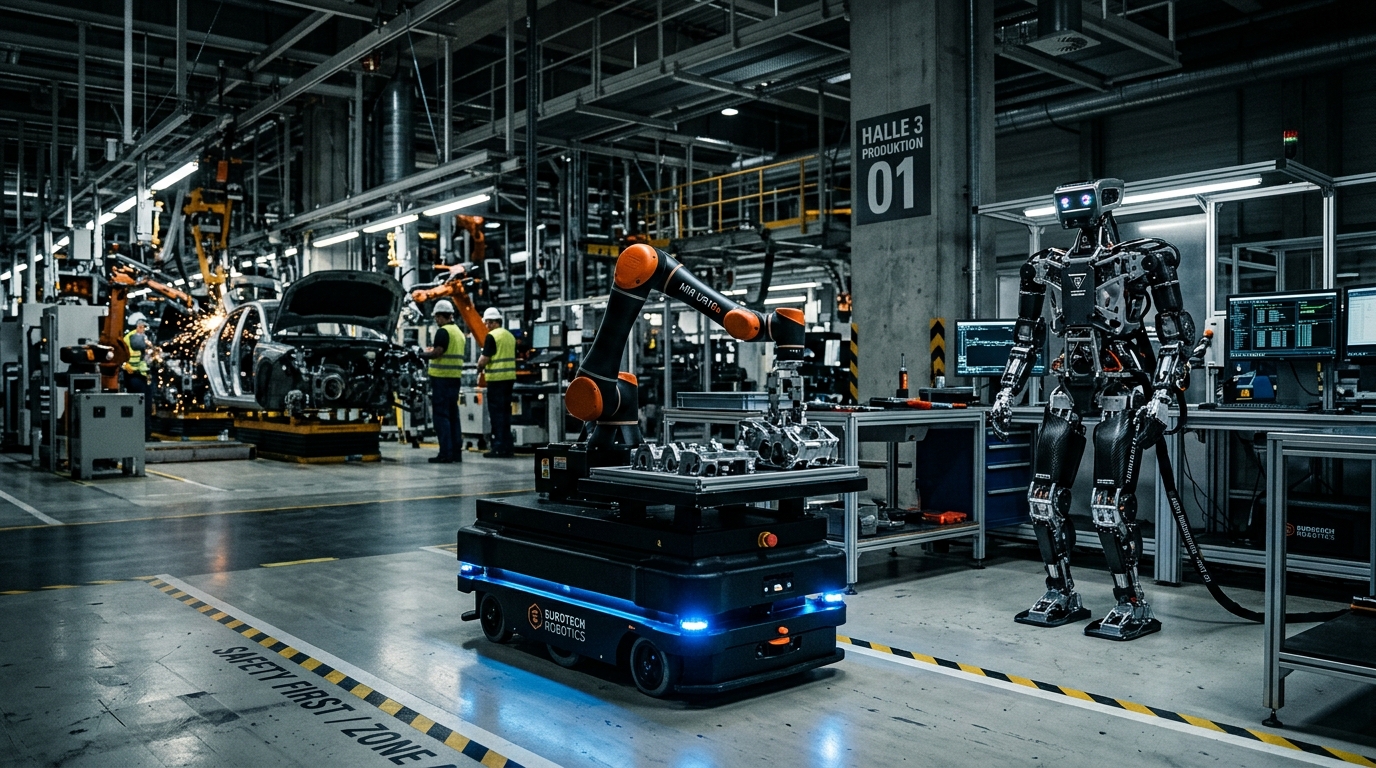
In August 2021, Elon Musk walked onto a stage at Tesla AI Day to announce a machine that would supposedly liberate humanity from manual labor forever. To demonstrate this historic breakthrough to the world, a human performer dressed in a skin-tight white spandex morphsuit walked out, breakdanced, and performed a tap routine while Musk deadpanned his vision of the future.
It was equal parts Silicon Valley circus and engineering hubris.
Fast forward five years. The spandex suit has evolved into an astonishing corporate narrative. Musk now promises that Tesla will manufacture 10 million Optimus units every year—a staggering cadence of one finished humanoid robot rolling off the line every three seconds, day and night, without pause. A sprawling production hall stretching more than half a mile is rising from the dirt at Giga Texas. Yet when senior equity analysts from JP Morgan flew out to Fremont to inspect the actual assembly line of the third-generation machine, what they were allowed to see was not a humming robotic ecosystem. They were shown a blue tarp covering an unfinished staging zone.
Meanwhile, headline feeds are saturated with hyper-curated video clips: humanoids cracking eggs, folding laundry at 0.5x speed after dozens of failed takes, or running simulated kung-fu drills in GPU clusters. In Germany and across Europe, top-tier automotive manufacturers—from BMW in Spartanburg to Mercedes-Benz in Berlin—are actively running pilot programs with machines from Figure AI and Apptronik.
The breathless press coverage insists that human labor is on the brink of immediate obsolescence. But if you walk the floor of a real manufacturing plant at 02:00 AM on a Tuesday, an entirely different set of physical laws applies:
- Why are multi-billion-dollar OEMs testing bipedal humanoids to do jobs that wheeled Autonomous Mobile Robots (AMRs) have handled reliably for a decade?
- Are these machines truly versatile human replacements, or are they simply over-engineered, self-loading material mules?
- Why does the seemingly mundane task of grasping a wet plastic tote or threading a fastener remain an unsolved computational nightmare?
- And how long will it really take before a steel biped can safely enter an unstructured family household?
To answer these questions, we have to strip away the venture capital theatre, examine the physical kinematics of the 22-degree-of-freedom mechanical hand, revisit the hard operational lessons of Tesla’s infamous 2018 “production hell,” and separate mechatronic reality from speculative fiction.
General-Purpose Autonomous Worker
✦Universal versatility: End-to-end neural networks learning any household or factory task instantly from video clips.
✦Immediate mass rollout: Millions of humanoids replacing skilled operators, welders, and domestic maids by 2027.
Brownfield Self-Loading Mule
✦Brittle single-task policies: Fenced trial cells moving rigid sheet metal blanks or totes with 0% to 90% multi-finger grasp reliability.
✦Severe hardware fragility: Forearm tendon friction, motor thermal throttling, and lack of deterministic safety certification (ISO 13849).
1. The Historical Amnesia: Tesla’s 2018 “Alien Dreadnought” and the Tent Lesson
To understand why the current humanoid timeline is detached from reality, one only needs to examine industrial history. This is not the first time the manufacturing sector has been told that humans are obsolete and that full automation is only quarters away.
A decade ago, during the ramp of the Tesla Model 3, Elon Musk declared that the factory itself was the true product. He christened his vision the “Alien Dreadnought”—a production facility so thoroughly automated that human workers would be banned from the floor because their physical presence would slow the line to “human speed.” Tesla bypassed the standard automotive commissioning playbook. Rather than building cheap, soft prototype tooling to iron out geometric tolerances, panel gaps, and stamping variances, Tesla ordered permanent, high-speed automated machinery directly from 3D CAD files.
The result was an industrial disaster known as “Production Hell”:
- Stamping presses misaligned, complex pneumatic handling conveyors jammed continuously, and automated optical inspection systems shut down lines over microscopic shadows.
- A robot Musk personally nicknamed “Flufferbot” was commissioned to pick up fluffy fiberglass sound-dampening blankets and glue them onto battery packs. The machine repeatedly tangled the blankets, dropped them, or glued them sideways, halting the line dozens of times per shift.
- After months of grueling engineering triage, Tesla’s automation engineers made a humiliating discovery: the fiberglass blanket was acoustically unnecessary. The automated cell had spent months paralyzing vehicle production to install a part that was subsequently deleted from the bill of materials.
How was Tesla saved from imminent bankruptcy? Not by a software patch or an alien dreadnought. Tesla survived by erecting a massive canvas sprung tent in the parking lot of the Fremont plant.
Inside that tent, ordinary human workers armed with manual ratchet wrenches, pneumatic screwdrivers, and rolling wooden carts assembled thousands of Model 3s by hand. One out of every five vehicles that pushed Tesla over its survival threshold of 5,000 cars per week came out of that makeshift tent.
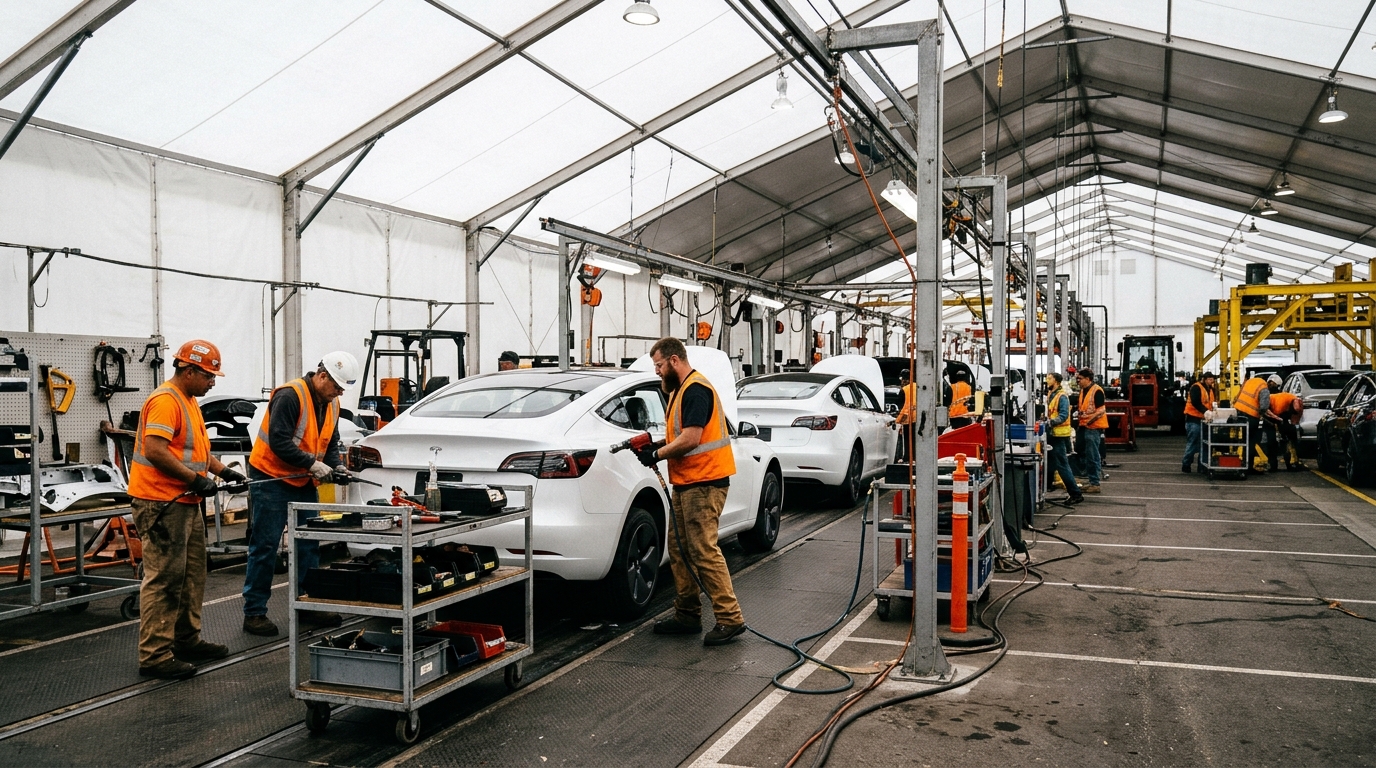
In April 2018, Musk was forced to post an extraordinary public confession on Twitter:
“Yes, excessive automation at Tesla was a mistake. To be precise, my mistake. Humans are underrated.”
Yet today, that hard-learned operational lesson has been entirely inverted. The very same leadership that discovered a robotic arm couldn’t reliably glue a soft fiberglass mat to a battery without shutting down an entire car plant is now claiming that a two-legged machine with 22 tiny tendon-driven fingers will fold your soft laundry, wipe down your kitchen counters, and assemble finished motor vehicles—all coordinated by neural networks that have never survived a 24/7 manufacturing audit.
Building a half-mile concrete factory hall in Texas for “Gen 4” before “Gen 3” can reliably thread a bolt without human teleoperation is the exact same failure pattern as the 2018 alien dreadnought, reimagined on mechanical legs.
"Excessive automation was a mistake... Humans are underrated."
Elon Musk’s official reflection following the 2018 Model 3 production collapse — an insight now forgotten in the race for humanoid venture capital.
2. Showmanship vs. Mechanics: Silicon Valley Staging vs. Chinese Rapid Prototyping
The divergence between media perception and physical execution becomes even starker when comparing the development cultures of the United States and China.
In Silicon Valley, humanoid robotics is largely treated as a valuation lever. Companies operate under extreme marketing discipline: tightly scripted 15-second video clips, high-framerate camera tracking, dynamic jump cuts, and non-disclosure agreements that forbid visitors from inspecting machines behind the curtain. When third-party observers do get close, the reality often collapses:
- In corporate presentations, robots are routinely teleoperated behind the scenes by human operators wearing virtual reality headsets and haptic gloves, with the teleoperation disclosure buried in tiny footnotes or omitted entirely.
- Generation numbers are incremented based on investor presentation calendars rather than mechatronic milestones. Gen 4 is announced before Gen 3 has logged a thousand hours of autonomous factory operation.
By contrast, Chinese manufacturers are treating humanoid robotics not as an existential AI philosophy, but as a ruthless mechatronic manufacturing race:
XPeng "Iron" vs. The Spandex Legacy
When Chinese electric vehicle manufacturer XPeng unveiled its bipedal robot "Iron," the machine walked across the runway with such fluid, natural kinematics that western social media immediately branded the demonstration a fake, insisting a human performer was concealed inside the casing—an ironic nod to Tesla's 2021 debut.
Rather than issuing a defensive PR clarification, XPeng CEO He Xiaopeng returned to the stage the very next morning with a utility knife. Live on camera in front of hundreds of journalists, his team sliced open the composite shell of the robot's thigh and shin, exposing the harmonic reducers, brushless DC motors, planar bearings, and internal wiring harnesses to prove zero biological components existed.
Yet even with aggressive hardware iteration and plummeting actuator costs in Shenzhen, Chinese and Western builders face the exact same physical barrier once their robots touch a production line: hardware is only the muscle. The control policies and tactile perception are fundamentally immature.
3. What Can They Actually Do Today? (And the Next 6 to 12 Months)
If you filter out the CGI demos, what are humanoid robots actually doing inside operational factories in late 2026?
Real-world pilots exist, but their physical boundaries are strictly circumscribed:
- BMW Plant Spartanburg (Figure 02): Figure AI has placed bipedal units inside BMW’s body shop. What do they do? They pick up stamped sheet metal blanks from a standardized parts rack and walk approximately 1.5 meters to place them into an assembly fixture with locating pins. During the critical insertion phase, the robot’s feet remain completely stationary. It is acting as a mobile torso, performing a repetitive pick-and-place operation within a carefully laser-guarded perimeter.
- Mercedes-Benz Berlin-Marienfelde (Apptronik Apollo): Mercedes is evaluating Apollo for parts kitting. The robot takes bins off delivery tuggers, checks barcodes, and places them onto staging racks for line-side logistics.
- Tesla Fremont & Giga Texas (Optimus Gen 2/3): Tesla has deployed small batches of Optimus units inside its own battery cell and casting facilities. They carry plastic battery module carriers from roller conveyors to transport carts. Every unit operates inside fenced enclosures with safety interlocks, constantly shadowed by software engineers ready to hit the physical E-stop.
Current Reality (Q4 2026 – Q1 2027)
Strictly bounded brownfield pilots. Robots operate in designated safety cells moving rigid objects (sheet metal, injection-molded totes) between fixed heights. Multi-finger dexterity is rarely utilized; most pilots use simplified 2-finger parallel grippers or suction cups bolted to humanoid arms. Operating speeds are 30% to 50% of an experienced human worker.
The 6 to 12 Month Horizon (By Summer 2027)
Expansion of "self-loading material mule" deployments. Robots will transition from carrying one tote at a time to multi-bin kitting on factory floors. End-to-end Vision-Language-Action (VLA) models will improve tolerance to slight workpiece misalignments (±50 mm). However, robots will not perform flexible wiring harness routing, high-torque bolting, or unstructured maintenance tasks. They will remain tethered to structured industrial environments.
The Long-Term Horizon (2035+)
True general-purpose autonomy capable of navigating unstructured dynamic spaces, handling deformable non-rigid objects (textiles, wet food, loose cables), and operating safely alongside unmonitored human beings without physical or virtual safety cages.
4. The Core Mechanical Bottleneck: Why the 22-DoF Hand Breaks Moravec’s Paradox
Why can an artificial intelligence pass the German Bar Exam, generate photo-realistic cinema, and write complex C++ firmware in seconds, yet a multi-million-dollar robot cannot reliably clear an IKEA table or pick a wet sponge out of a sink?
The answer was formulated in 1988 by roboticist Hans Moravec, Rodney Brooks, and Marvin Minsky: Moravec’s Paradox.
“It is comparatively easy to make computers exhibit adult level performance on intelligence tests or playing checkers, and difficult or impossible to give them the skills of a one-year-old when it comes to perception and mobility.”
The reason is evolutionary. Abstract reasoning, mathematics, and symbolic language are brand-new biological adaptations, barely a few hundred thousand years old. They operate on clean, discrete logical rules.
Sensory-motor coordination, dynamic balance, and tactile manipulation, however, are backed by over 500 million years of vertebrate physical evolution. When you pick up a delicate wine glass, your brain is not running an abstract mathematical theorem; it is processing millions of tactile mechanoreceptors across your fingertips, instantly modulating gripping friction, skin deformation, and muscle co-contraction hundreds of times every millisecond.
The Engineering Nightmare of the Anthropomorphic Hand
Consider the human hand. It has 27 bones, 34 muscles, and over 20 degrees of freedom (DoF). The vast majority of the muscles that close your fingers are not located in your fingers at all—they sit in your forearm, pulling your fingers shut via long, flexible tendons routed through the narrow carpal tunnel of your wrist.
Cramming miniature electric brushless motors and planetary gearheads directly into the finger phalanges creates thick, heavy, clumsy paws. They lack grip force, overheat in minutes, and shatter upon the first accidental impact with a steel table.
Mimicking biology by placing 16 to 22 motors in the forearm requires routing ultra-thin synthetic cables (Dyneema or steel) across a multi-axis articulating wrist. When the wrist twists, cable tension spikes, friction escalates, tendons stretch and fray, and the tightly packed forearm turns into a 70°C thermal bottleneck.
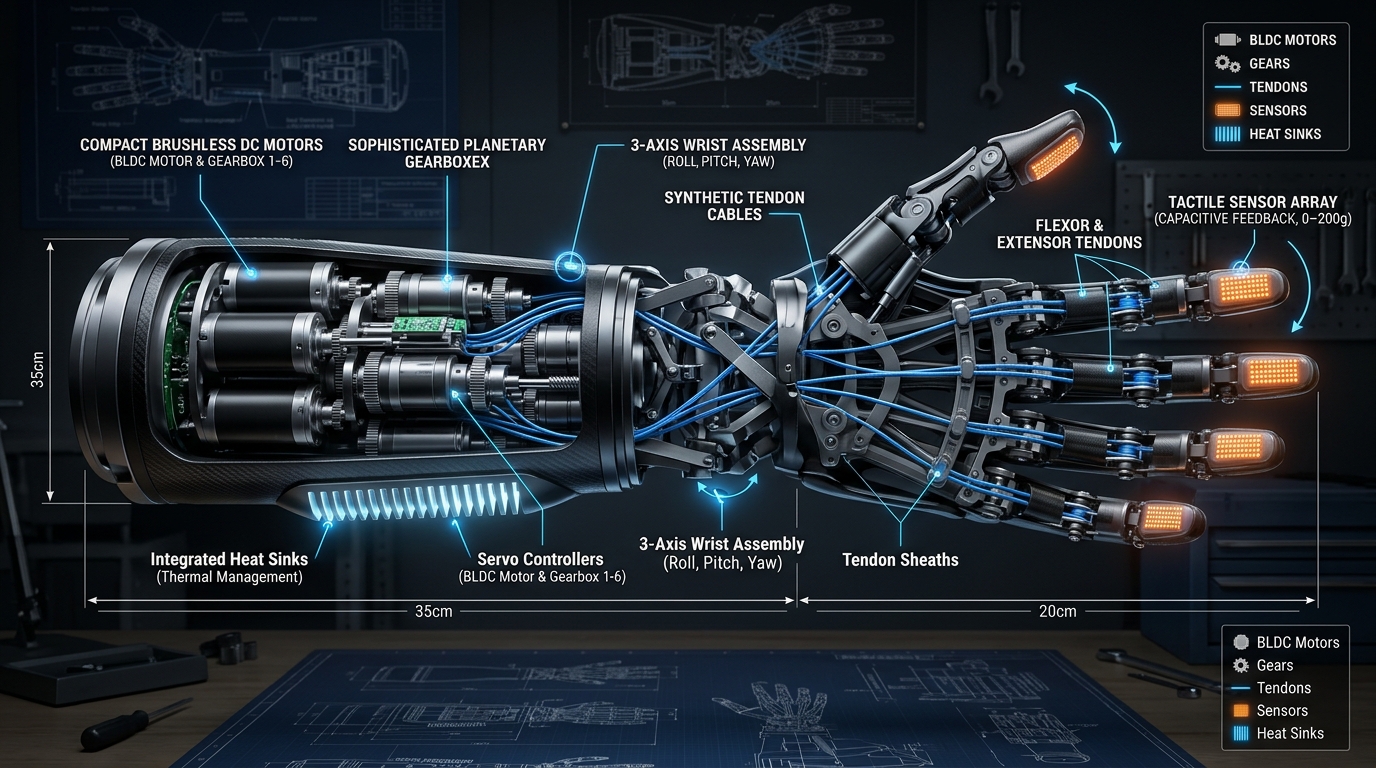
This is not a theoretical software glitch; it is an unforgiving materials science and mechanical packaging trap:
- A single 22-DoF humanoid hand and forearm assembly contains more than 100 high-precision micro-screws, tensioners, encoders, and thermal sensors. Many must still be hand-assembled with tweezers under a microscope.
- When Figure AI concluded its trial deployment at BMW’s Spartanburg plant, engineers acknowledged that the forearm and wrist assembly was the single component that suffered the highest failure rate under continuous shift operation.
- For Tesla, reports indicated that fully built robot torsos were piling up in storage areas during 2024 and 2025 because the production line could not assemble functional, durable hand units fast enough to match the chassis output.
Furthermore, in benchmark evaluations published by MIT CSAIL and Google DeepMind Robotics, multi-finger grasping success rates in semi-structured environments range between 0% and 90%.
On a YouTube video, a 90% grasp success rate looks like a miraculous technological triumph. On an automotive assembly line producing 1,000 cars a day, a 90% success rate means the robot drops, crushes, or misaligns 100 components every single day. That is not innovation—it is an immediate, catastrophic line stoppage.
0% – 90%
Multi-finger grasping success rate in experimental labs vs. 99.98% required on factory lines
5. The AMR Truth: Are Humanoids Just Over-Engineered “AMRs with Hands”?
If multi-finger hands are fragile and bipedal walking is mechanically inefficient, why are manufacturing conglomerates paying hundreds of thousands of dollars to evaluate humanoid forms?
To answer this, we must examine the workhorse of modern factory logistics: the Autonomous Mobile Robot (AMR).
AMRs are an established, highly mature industrial technology:
- Built on low-slung, wheeled steel chassis with an ultra-low center of gravity.
- Navigating effortlessly using industrial safety LiDAR, 3D Time-of-Flight (ToF) cameras, and SLAM algorithms.
- Certified under strict international machinery standards (DIN EN ISO 3691-4), automatically projecting dynamic laser safety fields that decelerate or halt the vehicle whenever an operator steps into its path.
- Capable of carrying payloads from 500 kg to 1,500 kg for 8 to 12 hours on a single battery charge, costing between €25,000 and €45,000.
The Pragmatic Industrial Machine
✓Zero balance overhead: Stable 4-wheel kinematic footprint consumes zero battery power to remain stationary.
✓Deterministic Functional Safety: ISO 3691-4 and ISO 10218-1/2 certified safety circuits with hardware-redundant fail-safes.
✓High payload & uptime: 10+ hour continuous shift endurance carrying 500+ kg without joint thermal derating.
✗Architectural limits: Cannot climb stairs, step over high physical sills, or squeeze into narrow 500mm human-only gaps.
The Experimental Anthropomorph
✓Brownfield spatial drop-in: Matches human vertical reach (0.2m to 2.0m) and fits directly into legacy manual workstations.
✗Parasitic energy draw: Consumes 300W to 800W continuously just running balance loops against gravity, killing battery runtime (60–90 min).
✗Dynamic falling hazard: A 70-kg metal biped that loses balance is an uncontrolled ballistic mass with no SIL 3 certified safety zone.
✗Punishing CapEx & MTBF: 30 to 50 active harmonic actuators multiplying potential points of mechanical failure.
Why Can’t the AMR Alone Solve the Problem?
The standard AMR has one fatal limitation on the brownfield factory floor: it has no hands.
An AMR is an autonomous flatbed or pallet mover. It cannot load or unload itself. To transfer a plastic tote from an AMR onto an assembly line roller rack, an industrial plant must choose between two expensive compromises:
- Build fixed infrastructure: Install automated motorized roller conveyors, pneumatic docking stations, or scissor lifts at every single workstation. In an existing European car plant, tearing up concrete floors to route power and install hundreds of meters of transfer conveyors can cost tens of millions of euros and trigger weeks of catastrophic production shutdowns.
- Assign a human worker: Pay a human operator €50/hour across the night shift simply to stand by the line and lift boxes off the AMR as it arrives.
This reveals the real, unvarnished economic purpose of early humanoid trials: They are not general-purpose thinkers. They are self-loading AMRs.
Automakers are buying humanoids to serve as autonomous brownfield mules. The humanoid enters an existing factory built for humans, walks down narrow manual aisles without ripping up floor concrete, reaches into an existing shelf, lifts a standard KLT container, and carries it to the next station.
The Physics Dilemma: Wheels vs. Legs
If the objective is simply a self-loading material mule, why put it on two legs?
On a flat factory floor, bipedal walking is a mechanical absurdity:
- Standing upright on two inverted pendulums requires continuous, high-frequency closed-loop motor torque (running at 200 Hz to 500 Hz). The robot burns substantial battery power just preventing itself from falling over.
- A wheeled mobile manipulator (an industrial AMR base equipped with a 6-axis collaborative arm, such as a Universal Robots or Robco arm) accomplishes the exact same self-loading task. But it does so with five times the battery endurance, one-third of the mechanical parts, vastly higher payload capacity, and zero risk of toppling over onto a worker.
The only physical justification for two legs is navigating stairs, stepping over pipeline curbs, or traversing deep gravel. How many modern manufacturing halls have stairs between the warehouse and the assembly line? Exactly zero.
The biped form factor on factory floors is primarily driven by venture capital optics and brownfield reach envelope mimicry—not physics.
6. The Data Illusion: Why “Watching YouTube” Won’t Clean Your Kitchen
The primary narrative fueling the humanoid investment boom is the belief that robotics is experiencing its own “ChatGPT moment.” The assumption goes: Just as Large Language Models conquered language by ingesting the internet, robotics will conquer physical manipulation by training on millions of hours of video.
This mental model represents a profound category error.
Discrete Language Tokens vs. Continuous Dynamical Control
A large language model generates discrete text tokens. If the GPU inference engine pauses for 800 milliseconds to calculate the next word, nothing catastrophic happens; the user simply waits. The output space is abstract and disembodied.
A humanoid robot is a high-bandwidth dynamical system interacting with rigid and deformable matter. It must stream continuous vectors of joint angles, velocities, and motor torques across 30 to 50 joints at 200 to 500 Hz. If the neural policy hesitates for 20 milliseconds or misjudges contact friction by 10%, gravity instantly executes a physical penalty: the robot loses dynamic balance and smashes its head on the epoxy floor.
The Non-Existent Physical Internet
LLMs were trained on trillions of tokens scraped from Wikipedia, GitHub, scientific papers, and digitized books for virtually zero acquisition cost.
There is no internet of physical manipulation data. No database exists that records the micro-torques, shear stresses, and tactile slip responses of humans spreading butter, handling oily sheet metal, or folding damp towels.
The Sim-to-Real Mirage
To bridge this data void, robotics labs rely heavily on physics simulators like Nvidia Isaac Sim and MuJoCo. Inside a virtual GPU cluster, thousands of digital robots can practice picking up a cup millions of times overnight. If a digital robot drops the cup, no glass breaks.
The problem is the Sim-to-Real Gap:
- Physics engines simulate contact mechanics using rigid-body approximations. They simplify surface friction, damping, cable elasticity, and thermal expansion.
- In simulation, every steel part has perfect CAD geometry and uniform surface roughness. On a factory floor, parts arrive with microscopic burrs, oily residues, stamped tolerances that vary by ±1.5 mm, and ambient temperatures that swing by 15°C between day and night shifts.
- A control policy that boasts a 99% success rate in Isaac Sim often degrades to less than 60% when confronted with the optical glare, ambient vibration, and greasy dust of a live machine shop.
The Sweatshop of Teleoperation
Because simulation alone cannot solve the gap, companies have resorted to manual teleoperation:
- Tesla and Figure dress human operators in VR headsets, sensory gloves, and 30-kg camera backpacks.
- Operators spend entire 8-hour shifts manually teleoperating the robot through repetitive everyday tasks—picking up plastic blocks, opening drawers, moving mugs, wiping tables. One former operator accurately described the job: “It is pure cardio all day long.”
- Figure AI’s “Index” data platform boasts of ingesting thousands of hours of third-person and first-person human video. But as any experienced machinist knows: Watching 1,000 cooking videos teaches a robot nothing about how hard to squeeze an egg without shattering the shell.
Optical cameras see pixel colors; they cannot see normal forces, shear vectors, compliance, or tactile friction. Without embedded, durable high-resolution tactile sensors on every fingertip, video-trained models remain mechanically blind.
7. The Domestic Fantasy: Toddlers, Hot Stovetops, and the Cold Restaurant Floor
If deploying humanoids in clean, 5S-structured automotive factories is proving this difficult, what does that say about the Silicon Valley promise of a household robot butler folding your clothes and unloading your dishwasher by 2028?
The brutal engineering reality: A private home is three orders of magnitude more complex, unstructured, and hazardous than a car plant.
Factory Environment
✓Uniform Epoxy Floors: Level surfaces with clear, high-contrast floor markings and defined traffic paths.
✓Rigid CAD-Modeled Parts: Predictable metal/plastic workpieces with fixed pick points and known mass.
✓Controlled Lighting: Consistent overhead industrial illumination under strict 5S shopfloor discipline.
✓Trained Personnel: Adult operators equipped with standard PPE operating outside laser safety zones.
Domestic Environment
✗Slippery Rugs & Toys: Loose cables, shifted furniture, and uneven floor thresholds that trip balance loops.
✗Deformable & Fragile Objects: Soft wet laundry, dynamic fabrics, and clear glassware confusing depth sensors.
✗Dynamic Sunlight & Shadows: Direct window glare, moving blinds, and dark corners corrupting vision models.
✗Children, Pets & Stoves: Unpredictable toddlers crawling near 150 Nm actuators and boiling pots of water.
Consider what a domestic robot must handle on an ordinary Saturday morning:
- Soft, non-rigid deformable objects: a wet towel tangled in a laundry basket behaves differently every time it is touched.
- Fragile, transparent materials: clear drinking glasses that reflect ambient sunlight and confuse Time-of-Flight depth sensors.
- Severe spatial clutter: pet toys, loose electrical cables, and uneven carpets that trip dynamic bipedal balance controllers.
The Lethal Mass of Domestic Steel
Beyond spatial complexity lies an insurmountable functional safety barrier: ISO 13849, Performance Level d/e, and ISO 10218.
A domestic humanoid is not a lightweight plastic toy; it is an industrial machine:
- Total mass ranges between 65 kg and 85 kg of solid aluminum, carbon fiber, steel gears, and high-voltage lithium battery packs.
- Its joints are powered by high-torque permanent magnet motors capable of exerting 80 to 150 Newton-meters of instantaneous torque—more than enough force to crush an adult’s hand, snap a forearm, or crack an infant’s skull.
- In industrial plants, cobots that operate near humans must comply with strict power and force limiting (PFL) regulations. If an unexpected contact occurs, certified safety circuits cut drive power within milliseconds.
How does an uncertified, non-deterministic end-to-end neural network guarantee that an optical hallucination or a reflective kitchen window won’t cause the robot’s arm to accelerate at full torque into a toddler running around the kitchen island?
Under European CE marking directives and machinery safety laws, you cannot certify a statistical neural network as a safety-critical barrier. A machine capable of inflicting catastrophic mechanical trauma cannot be placed into an uncontrolled domestic environment with children and pets until it possesses deterministic, hardware-redundant, fail-safe supervisory layers.
Independent robotics researchers at MIT CSAIL and European safety certification bodies agree: A general-purpose domestic robot capable of autonomous household chores without human supervision is at least 10 to 15+ years away.
TRL 7–8: Structured Brownfield Material Transfer
Moving rigid KLT bins, palletizing standardized cartons, machine tending with fixed locating fixtures.
TRL 4–5: Semi-Structured High-Mix Assembly
Dual-arm kitting, parts sequencing, inserting blanks into clamping fixtures with laser supervision.
TRL 2–3: Unstructured Domestic & Service Autonomy
Handling hot cooking surfaces, laundry folding, clearing fragile dinnerware near children. High hazard; uncertifiable today.
The Gastronomy & Hospitality Illusion
The over-automation trap extends directly into the service sector. Silicon Valley pitch decks frequently propose replacing restaurant waitstaff with humanoid servers.
Yet anyone who has dined in an automated trial restaurant knows the experience is cold, clattering, and deeply anti-social. A clunky steel biped carrying a plate of food provides zero warmth, cannot handle an empathetic request, and turns a relaxing social dining ritual into a tense mechanical obstacle course.
Technology is meant to liberate human beings from dirty, dull, and dangerous physical toil—not strip away genuine human connection from the spaces where warmth and hospitality are the entire product.
8. The Pragmatic SME Playbook: What Industrial Leaders Should Do Today
If you are a plant manager, technical director (Technischer Leiter), or custom machine builder (Sondermaschinenbauer) in Germany or Europe, how should you navigate the humanoid robotics avalanche?
The short answer: Do not write a €150,000 CapEx check for an experimental humanoid to do the job of a €20,000 AMR or a modular cobot.
While tech giants and venture-backed startups burn billions solving bipedal dynamics, manufacturing SMEs can capture massive productivity gains right now by following a disciplined, three-tier automation strategy:
Pillar 1: Solve Horizontal Logistics with Certified AMRs
If your operators are walking 10,000 steps a shift pushing manual carts or carrying plastic bins between CNC cells, deploy certified Autonomous Mobile Robots today. Standard wheeled AMRs navigate your existing aisles, respect safety laser zones, integrate with your MES via standardized protocols (VDA 5050), and deliver immediate payback in 9 to 14 months without a single falling hazard.
Pillar 2: Deploy Modular Collaborative Arms for Machine Tending
Do not wait for a 22-DoF humanoid hand to learn how to open a CNC door. Modular collaborative robotic arms (such as 6-axis cobots from Universal Robots or German modular builders like Robco) mounted on fixed pedestals or wheeled carts can load and unload milling machines, stamping presses, and injection molding lines today with 99.98% repeatability and 24/7 reliability. Use simple, hardened two-jaw electric parallel grippers or vacuum cups—not fragile anthropomorphic tendons.
Pillar 3: Invest in the Software & Middleware Backbone
The ultimate value of future robotics will not reside in who manufactured the cast aluminum leg or the brushless motor. It will reside in the software intelligence directing the shopfloor:
- How clean are your machine-to-machine APIs?
- Can your plant orchestrate robots, PLCs, and camera inspection stations via MQTT, OPC UA, and ROS 2?
- Have you deployed edge vision systems that run locally on industrial PCs to perform automated optical quality inspection without cloud latency or data sovereignty risks?
If you build an open, API-driven middleware foundation today, you will be able to plug in any physical embodiment—whether it is a wheeled cobot, an AMR, or eventually an affordable humanoid—as a routine physical peripheral to your IT stack.
As Roman Hölzl, CEO of German robotics pioneer Robco, succinctly observed:
“The mission of modern industrial automation is to automate the ordinary, so that human beings can orchestrate the extraordinary.”
Humans are not clumsy biological bottlenecks waiting to be purged by an alien dreadnought. Humans are the adaptable, intelligent orchestrators of quality, judgment, and complex exception handling. The factories that win the next decade will not be the ones that replace their workforce with dancing spandex illusions, but the ones that arm their people with reliable, high-uptime software and pragmatic automation.
Deploying Automation Systems or Need Software to Direct Your Shopfloor?
Physical machines, mobile platforms, and cobot arms are only as capable as the software directing them. Mintmal helps engineering teams, custom machine builders, and industrial plants build the software layer around physical automation: developing custom Python/MQTT/ROS 2 middleware, deploying edge vision for automated quality inspection, and building sovereign, on-premise data pipelines.

About Mintmal
Mintmal delivers practical AI and software systems with engineering rigor from Wuppertal, Germany. From AI telephone automation for trades to sovereign open-source systems.